Do you want to be found on Google? Master keyword research first.
Keyword research doesn’t just involve finding random keywords. It’s about figuring out what your target audience wants. Then, you can deliver precisely what they want.
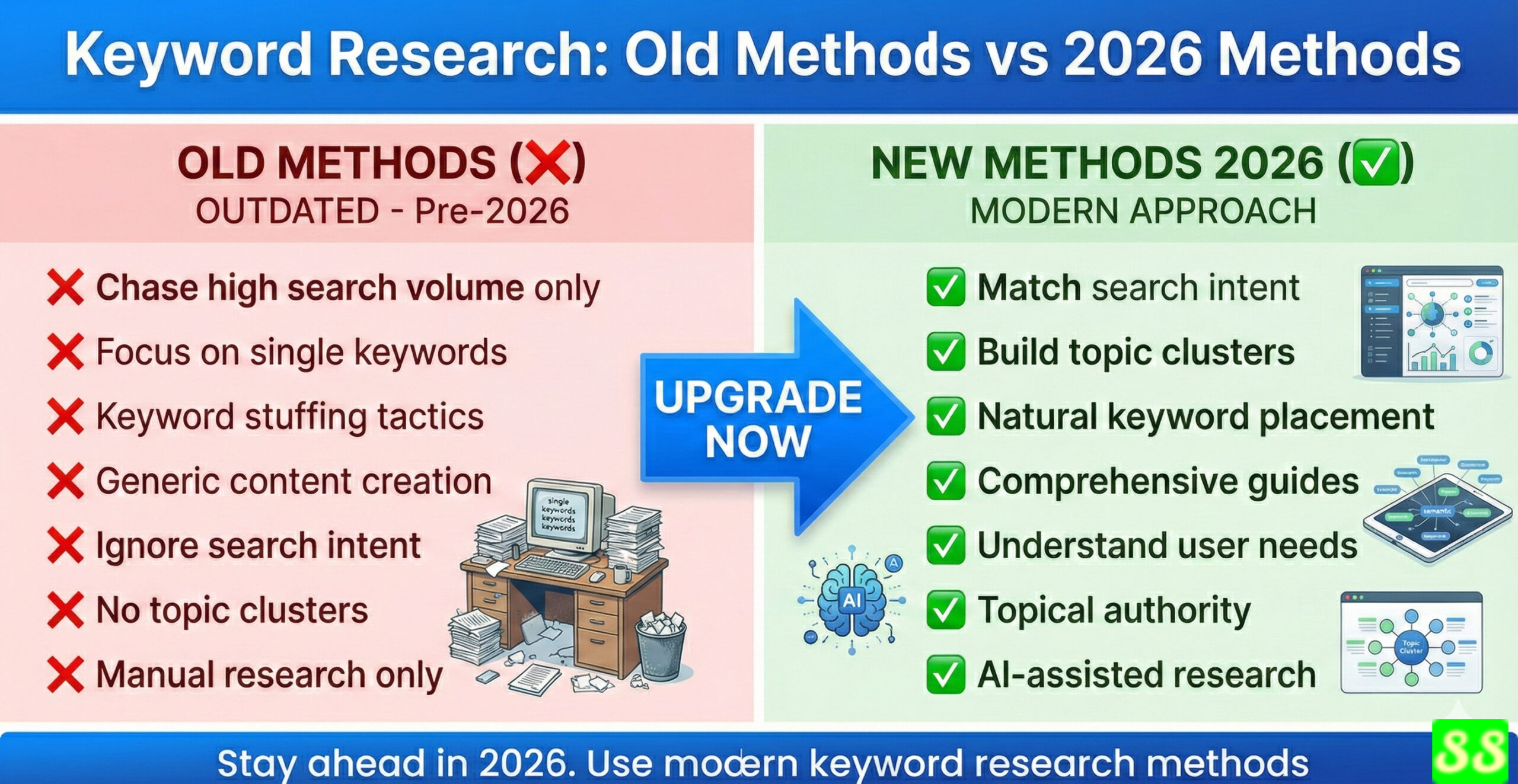
In 2026, the rules was changed. AI tools such as ChatGPT can now respond to questions directly. Google’s Search Generative Experience (SGE) provides AI summary. Voice search is growing. Traditional methods for locating keywords are no longer effective.
This guide will teach you the latest keyword research. You’ll be taught the exact process we employ. At the end you’ll have a keyword strategy that is ranked.
Let’s start.
What is the reason Keyword Research for 2026 Matters
Search engine optimization is the underlying principle for SEO.
You’re just guessing. You may write a great piece of content. But if no one is searching for it, no one discovers it.
The truth is that 90percent of sites don’t do the keyword research. They write according to what they feel is right. Then they ask themselves what they’re doing wrong.
The websites that are ranked? They conduct keyword research first. They then write.
What has changed since 2026?
The old keyword research focused on volume of search. More volume means increased traffic. Simple, right?
No more.
Search behavior evolved. Nowadays, people speak in a conversational manner. “What does keyword research mean” was replaced by “How to find the right keywords that will help me write my own blog.” AI tools can answer questions in a flash. Google provides AI summary first.
This signifies:
- It is less important to consider volume than its importance
- More important is intent than precise matches.
- Topic ownership is more important than single keyword rankings
- Understanding semantics is everything
The main point The modern keyword research in 2026 is about finding the appropriate subjects, not just the right keywords.
Let’s develop your strategy for identifying keywords.
Step 1: Determine Your Business Goals
Don’t chase keywords blindly.
First, determine what you are looking for. Do you sell products? Building authority? Building leads? Each goal needs different keywords.
This process takes about 30 minutes. This is the most crucial 30 minutes of your life.
What do you really want?
Consider these issues:
Question 1: What’s Your Primary Goal?
- Drive sales
- Generate leads
- Create authority/traffic
- Increase brand recognition
- Establish expertise
Question 2 Who are your customers?
- Age and job title, as well as the location
- Pain points that they have
- Problems that they solve
- What language do they use?
- Where do they look?
3. What makes you Different?
- Your unique angle
- Your experience
- Your audience
- Your expertise
- What are the things competitors don’t do
Example: Define Your Goal
We have an SaaS tools for managing projects.
Goal: Obtain qualifies leads (not just traffic) Audience: Small-sized business owners, between 28 and 45 years old. Bootstrapped.. Pain points manual workflows, team communications and deadline tracking They use the following language: “Simple project management,” “No learning curve,”” “affordable”
Then we’re aware that we are targeting the decision-makers not novice keywords.
Try it: Write down your goals. Write down your ideal client. Give three things that distinguish you from the competition.
You have now got your foundation.
Step 2 Step 2: Create Seed Keywords
Keywords for Seed are your first step.
These are broad topics you’d like to be a part of. They’re not yet the final keywords. The foundation is all that remains.
Consider the seed keywords as large buckets. Each bucket will be filled with smaller, more specific keywords later.
How do I Create Seed Keywords
You need 8-12 main seed keywords. Here’s how to locate them:
Method 1: Brainstorm (Brain, Not Tools)
Sit down. Consider your company. Write down what people want from you.
“What’s the most efficient way to organize projects?” “How do I monitor the progress of my team?” “What’s more affordable as Asana?”
These are seed words that become the basis for:
- Management of projects
- Team collaboration
- Task management
- Automation of workflows
- Planned project
Pro-tip Contact your sales staff. They hear customer questions daily.
Method 2. Google Autocomplete
Visit Google. Enter your main search phrase. Check what comes up.
Enter “keyword research” — Google suggests:
- Keyword tools for research
- Keyword research tutorial
- Keyword research meaning
- how to conduct keyword research
These are keywords that serve as seed. Real people use these keywords.
Method 3 Method 3: Make use of AI (Faster)
Open ChatGPT. Set it in context.
Prompt: “I run a SaaS project management tool for small-sized businesses. Give me 15 key keywords that we should be targeting for our seed. Concentrate on decision-making language not the beginner keywords.”
ChatGPT will give you an instant list. It takes about 2 minutes.
AI advantage: You get seed keywords fast. You avoid bias.
Method 4: Examine Competitors
Check out what competitors are ranked for.
Visit Semrush (free trial). You must enter their domain. Find the some of the top keywords.
Note: What terms do they rank for? Which gaps are there? What keywords do they NOT focus on?
A List of Keywords to Your Seed
Create an easy spreadsheet:
Seed Keywords Project Management Teams can manage their projects with Workflow automation Tools for collaboration with teams Agile project management Software for managing tasks and planning resources time tracking for teams Gantt chart software for Team productivity toolsDone. You’ve got your starting point.
Step 3: Identify the Search Intent
This step differentiates the winners and losers.
The reason one searches. Learn intent and rank higher.
There are four kinds of search intention:
Type 1 of Intent Informational
The user needs to know.
They’re in the process of learning, not purchasing. They’re asking questions. They are looking for answers.
Keywords: “What is,” “How to,” “Explain,” “Why is,” “Guide to,” “Tutorial”
Examples:
- “What is keyword research”
- “How do I do keyword research”
- “Keyword research guide”
Type of content Types of Content: Blog posts guidebooks, tutorials and explainers
Your action: Write detailed guides. Answer questions. Make yourself appear as an the expert.
Intent Type 2 Intent Type 2: Navigational
The user would like to visit an exact web page.
They’re in search of a name. A tool. A business.
Keywords Names of brands or company names, app names
Examples:
- “Ahrefs login”
- “Semrush Keyword Tool”
- “Google Console” or “Google Console”
Content type: Brand pages login pages Product pages, login pages
Your actions Create HTML0 if you’re the company.
Intent Type 3: Commercial Investigation
A user looking at alternatives.
They’re getting close to buying. They evaluate. They do research. They look up reviews.
Keywords: “Best,” “Top,” “vs,” “Comparison,” “Review,” “Affordable,” “Cheapest”
Examples:
- “Best Keyword Research Tools 2026”
- “Semrush vs Ahrefs”
- “Free Keyword research tools”
Type of content: Comparisons, reviews, roundups “best from” lists
Your step: Create content that compares. Demonstrate the strengths of your tool.
Type 4 of Intent Type 4: Transactional
A user has been now ready to sign up or purchase.
They would like to change. Now.
Keywords: “Buy,” “Sign up,” “Get,” “Try,” “Subscribe,” “Download”
Examples:
- “Buy Semrush”
- “Start FREE Ahrefs trial”
- “Download Keyword Research Template”
Content type: Sales pages, product pages, sign-up pages
Your choice is to make conversion simple. Eliminate any friction.
How to identify intent for Your Keywords
It’s simple. Look up each keyword in Google. Observe.
Keyword Research “how to conduct keyword research”
- Top 10 results include step-by-step directions
- Every result comes with pictures
- A majority of them are over 3000 words.
The intention is clear: informational. Users need precise tutorials.
Then you create a comprehensive instruction.
Search “best keywords research tools”
- The Top 10 are a compilation of articles
- With 10 tools, the Listicles include
- The reviews of each tool
The purpose is clear: commercial investigation. Users evaluate the tools.
So you create a comparison guide.
Your keyword strategy:
- Google each key word on Google
- Note: What is the most popular format? (guides, comparisons, reviews)
- Make sure that you match the format.
- Write better than your competitors
Step 4: Review Your SERP (Search Results)
Your competitors will show exactly what Google would like to see.
Examine the top 10 results. Take lessons from them. Then, beat them.
What to Look For in the Top 10 Results?
Check 1 Check 1: Content Format
Look up what appears to be:
To “How to conduct keyword research”:
- 7 of the results are step-by-step instructions
- 2 of them are videos
- One result is a device
Then you create a step by step guide. With video. And tool suggestions.
For “Best Keyword Research Tools”:
- 8 results are lists (10-20 tools)
- 2 results are tables of comparison
So you create a listicle. With a comparison table.
Check 2: Content Length
What’s the word count for the top 5 results?
Use the word counter for free. Paste top result. Verify length.
Usually:
- Pillar pages 3500-5000 words
- Pages of the cluster 1500-2000 words
- Quick answers 800-1200 words
The strategy is to match or beat length. However, only if it is worth the effort.
Do not write 5000 words just to fill in the blank space. Write 5000 words of valuable information.
Check 3 Check 3: Heading Structure (H2s)
What are the sections that top performers employ?
The top result shows these H2s:
- What is keyword research?
- Why it is important
- Step-by-step guide
- Common mistakes
- Tools to make use of
You create similar structure. Then add your unique angle.
Check 4: Snippets of Featured Content (Position 0)
What’s in the snippets of text that are featured?
Usually, a table or a short answer.
Can you create better? More detailed? Clearer?
If yes, then optimize it. Use a clear structure. Short paragraphs. Lists.
5. Check 5: People Also Ask (PAA)
Scroll down. Look for the “People Also Contact” section.
These are real-world questions that people are likely to.
Examples of “keyword research”:
- “What is the significance of seed keywords”
- “How do you calculate the keyword difficulty”
- “What’s the main difference between long and short-tail keywords”
- “How often do you change the keywords”
Gold mine Answer each PAA query in your piece. Create dedicated sections.
The SERP Analysis Template
Keyword: "How to do keyword research" Top Format: Step-by-Step guide Content Length average 4200 words. Common Sections: - Introduction Keyword research definition Step 1 2, 3 (process) Common errors Tools - FAQs Featured Snippet Format: List (8 steps) PAA Questions: 12 questions were found missing content: No AI tools are mentioned, and there are no 2026 updates. Your Plan Write a guide of 4500 words + AI section plus 2026 updatesStep 5: Locate Related Keywords and Create Clusters
This is the secret of 2026 to rank.
Don’t bother with single keywords. Create keyword clusters instead.
A keyword cluster refers to:
- 1 main pillar page (comprehensive guide)
- 8-12 pages from the cluster (supporting articles)
- All internal links
- A broad subject covered from every angle
Google recognizes this as subject authority. You are the one who owns the topic. You have a place in everything.
How to Find Related Keywords
Method 1. People Also ask
Search your main keyword. Scroll down. See PAA questions.
“Keyword research” shows:
- What is the purpose of keyword research to do?
- What is the best time to conduct keyword research?
- What are the five steps of keyword research?
- What’s the most effective keyword research tool?
They are referred to as cluster pages.
- “Keyword Research Steps”: Complete 5-Step Method”
- “How often should you conduct Keyword Research”
- “Best Keyword Research Tools 2026”
- “Why Keyword Research Matters”
Method 2. Google Autocomplete Variations
Type your main keyword. Note the variations.
“Keyword research” shows:
- Keyword tools for research
- Keyword research tutorial
- Keyword research definition
- Keyword research for beginners
- keyword research seo
- Keyword research strategy
- advanced keyword research
- Keyword research for free
Each page becomes a page of a cluster.
Method 3: YouTube Suggestions
You can visit YouTube. Search for your keyword. Note suggestions.
“Keyword research” suggests:
- Keyword research tutorial for novices
- advanced strategies for keyword research
- Keyword research tools review
- how to conduct keyword research
Real users use these sites to search. Develop content to them.
Method 4: Reddit and Forums
Visit Reddit. Find your subject. Check out what people have to say.
r/SEO shows:
- “Best free tool to research keywords?”
- “Keyword search to local SEO?”
- “How to find long-tail keyword phrases?”
These are some ideas for cluster pages.
Your Keyword Cluster Map
Main Pillar Page (3500-5000 words): “Keyword Research for 2026: Step-by-Step Instruction”
Web Pages for Clusters (1500-2500 words per):
- “What is Keyword Research? Complete Beginner Guide”
- The goal: “what is keyword research”
- “How to Find Seed Keywords: 4 Proven Methods”
- Goal: “seed keywords,” “how to find keywords”
- “Understanding Search Intent: 4 Types Explained”
- Goal: “search intent,” “search intent types”
- “Best Free Keyword Research Tools 2026”
- The goal: “free keyword research tools,” “keyword research tools”
- “Keyword Toughness Explained: How to Select Simple Keywords”
- The goal: “keyword difficulty,” “how to determine difficulty of a keyword”
- “Long-Tail Keywords”Long-Tail Keywords: Comprehensive Strategy and Exemples”
- The goal: “long-tail keywords,” “long-tail keyword research”
- “Keyword Research to E-Commerce Complete Guide”
- The goal: “ecommerce keyword research,” “product keyword research”
- “Local Keyword Research”: Take Control of Your City”
- Goal: “local keyword research,” “geographic keyword targeting”
- “Advanced Keyword Research Strategies for Pros”
- Goal: “advanced keyword research,” “professional keyword research”
- “Keyword Research Mistakes That Can Kill Rankings”
- Target: “keyword research mistakes,” “common seo mistakes”
What is the reason this Cluster Strategy Works
Google detects your pillar site connected to 10 other pages.
Google believes: “This website owns keyword research. They have everything covered.”
Google ranks you for:
- Keywords: “keyword research for 2026”
- Keywords related to this: “how to do keyword research”
- Long-tail: “keyword research for beginners”
- Commercial: “best keyword research tools”
- Local: “keyword research for local SEO”
You rank for the entire subject clusters. It’s not just one keyword.
Step 6: Prioritize and Organize Keywords
The search engine is not the only thing worth looking up.
Some are just too competitive. Some don’t have any traffic. Some don’t convert.
You need a system that can prioritize.
Make Your Own Keyword Matrix
Create a simple spreadsheet by using these columns:
| Keyword | Search Volume | Difficulty | Intent | Priority |
|———|—————|———–| ——–|———-|
| Keyword research | 8,100 | Hard | Info | Medium |
| How to do keyword research | 1,200 | Medium | Info | HIGH |
| Best keyword research tools | 2,400 | Medium | Commercial | HIGH |
| Seed keywords | 350 | Low | Info | HIGH |
| Keyword research for beginners | 450 | Low | Info | HIGH |
| Keyword difficulty | 900 | Medium | Info | MEDIUM |
| Long-tail keywords | 2,100 | Medium | Info | MEDIUM |
| Keyword research mistakes | 200 | Low | Info | LOW |
Priority Formula
Make use of this formula:
High Priority =
- Keyword difficulty Low to Medium
- Search volume: 200+
- Intent matches your goal
- A gap in ranking exists (competitors aren’t the perfect)
MEDIUM Priority =
- Keyword difficulty Keyword difficulty: Medium
- Search volume: 100-300
- Good intention match
- Content builds authority
Low Priority =
- Keyword difficulty Keyword difficulty (skip to now)
- Search volume: less than 100 (unless they change)
- Low intent match
The 2026 Smart Strategy
Do not chase keywords with high volumes all by yourself.
Instead, rank 10 keywords that are medium-volume = More traffic than one high-volume keyword.
Why? Medium keywords are less crowded. It is easier to rank.
Example:
- “Keyword research” = 8,100 search results, extremely difficult to rank
- 10 related keywords equals 1,200 + 900 + 450 + 350 200 searches per each equals 3,100 total traffic
Furthermore, you’re the expert. You rank for many keywords. Google detects this.
Step 7: Create Content that is ranked
Keyword research that is thorough and effective means nothing without excellent content.
Now you’re writing. But write smartly.
SEO Writing Formula for 2026
Rule 1 Rule 1: Answer Search Intent
Searches by users “How to conduct keyword research”
They want a step-by-step procedure. Clear, simple. Quick to grasp.
So you:
- Start with a brief summary
- Explain each step in detail
- Use screenshots
- Include the actionable advice
- End with the results
Rule 2. Make use of Keywords Naturally
Keyword density: 0.5-1.5%
For 3000-word article: Use main keyword 15-45 times.
Naturally. Not forced.
Don’t follow this advice: “Keyword research is vital. Do your keyword research first. Keyword research aids in ranking. The process of researching keywords …”
DO the following: “Keyword research is the basis of SEO. Before writing content, do keyword research. This research helps you understand the keywords people use to search. It can guide the entirety of your SEO method.”
Similar information. Natural flow. Better density.
Rule 3: Make Use of Related Keywords
Alternate your keywords. Use:
- Main keyword: “keyword research”
- Related: “keyword research tools,” “how to conduct keyword research,”” “keyword research method,”” “keyword research tutorial,”” “keyword research tips for beginners,”” “keyword research strategies”
Google recognizes these are linked. You will rank for all of them.
An example of density for a 3000-word article:
- “keyword research” = 18 times
- “keyword research tools” = 8 times
- “how to conduct keyword research” = 5 times
- “keyword research tutorial” = 4 times
- “keyword research tips for novices” equals 3 times
- “search intent” = 6 times
- “seed keywords” = 5 times
- Other variations = 10 times
Total: 60 keywords within 3000 words. That’s 22 percent density. Perfect.
Rule 4: Use short Sentences
Long sentences can confuse readers. Make confusion Google too.
It is difficult to comprehend: “Keyword research, which is the process of locating and analyzing search phrases that people use on search engines such as Google and Bing is essential to SEO success since it helps you know what your target audience is looking for, and create content that is in line with their search habits.”
This is simple: “Keyword research finds keywords that people search for. It’s essential for SEO. It helps you determine what your target audience is looking for. Then, you can create content that is compatible with your audience.”
Short wins all the time.
Rule 5: Use Active Voice
Active voice = subject performs the action Passive voice is when action is performed to the subject
Passive (weak): “Keyword research should be conducted prior to writing content.”
Active (strong): “Do keyword research prior to making content.”
Active voice is more powerful. Clearer. Better for SEO.
Rule 6 Use Subheadings (H2 H2)
Split content into parts. Utilize clear H2s.
H2s should:
- Include the main keyword or related keywords
- Define what’s in that section
- Be concise and clear
Example H2s:
- “How to Find Seed Keywords (4 Methods)”
- “Understanding Search Intent What is it that matters”
- “Best Free Keyword Research Tools 2026”
- “Common Keyword Research Errors to Avoid”
Rule 7: Provide Answers PAA Questions
Discovered 10 “People Also Ask” questions related to your search term?
Create dedicated sections. Answer each.
Use H3 for each question.
code >### What are Seed Keywords? Seed keywords cover a broad range of subjects you'd like to own... #What is the best frequency to Conduct Keyword Research? You should conduct keyword research every year... #What's the most effective Keyword Research Tool? The most effective tool is dependent on your requirements ...Rule 8 Use Bullet Points to assist in Scanning
Readers scan. They don’t have to read every word.
Use bullets to make lists. People scan bullets quickly.
Best methods for researching keywords Keywords that are low-competition that have a decent volume. Find a way to match search intent with the content format - Create keyword clusters and not just single keyword - Update keywords annually Make use of multiple tools to ensure accuracyRule 9: Include Real Examples
Theoretical thinking is dull. Examples sell.
“Seed keywords could include project management”, task tracking”, team collaboration”
Much better than general advice.
Rule 10: Use Schema Markup
Google loves structured data. It helps rankings.
Add three types:
Schema 1: Article Schema
{
  "@context": "https://schema.org",
  "@type": "Article",
  "headline": "Keyword Research for 2026: Step-by-Step Tutorial",
  "image": "image.jpg",
  "author": {
    "@type": "Person",
    "name": "Your Name"
  },
  "datePublished": "2025-12-08"
}
Schema 2: HowTo Schema (for step-by-step content)
{
  "@context": "https://schema.org",
  "@type": "HowTo",
  "name": "How to Do Keyword Research",
  "step": [{
    "@type": "HowToStep",
    "name": "Define your business goals",
    "text": "First, know what you want..."
  }]
}
Schema 3: FAQ Schema (for Q&A sections)
{
  "@context": "https://schema.org",
  "@type": "FAQPage",
  "mainEntity": [{
    "@type": "Question",
    "name": "What is keyword research?",
    "acceptedAnswer": {
      "@type": "Answer",
      "text": "Keyword research is..."
    }
  }]
}
SEO Checklist for On-Page
Before publishing, be sure to check each box:
Title Tag (60 characters maximum) “Keyword research for 2026: Step-by -Step Tutorial”
Meta Description (160 characters) “Learn how to find key words in 2026. Our complete tutorial explains the search intent keywords, seed keywords, and creating topic clusters. Get more visitors to your site.”
H1 Tag (Only one. Does not match the title) “Keyword Research 2026: Step-by-Step Instructions”
H2 Subheadings (8-12 throughout) Include the main and related keywords
Word Count (3500-5000 for pillar content) More detail = Higher rankings
Keyword Density (0.5-1.5%) Natural keyword placement
Related Keywords (Use 7 variations) Search intent Keywords, seed keywords long-tail keywords
Images (8-12 relevant images) Optimize alt text using keywords
Internal Links (10-15 links) Link to all pages of the cluster Use descriptive anchor text
External Links (5-7 authority websites) Link to Google, Ahrefs, Semrush and more.
FAQs (10-15 common questions) Answer real questions people ask
Schema Markup (Article How-To, FAQ) Helps Google comprehend the content
Page Speed (Under 3 seconds) Compress images. Reduce the code.
Mobile-Friendly (Perfect on mobile phones) Brief paragraphs. Big fonts. Simple to use.
Readability (Flesch score 60+) Simple words. Short sentences.
Internal Linking Strategy
Do not publish and forget.
Connect this page to all of your cluster pages.
Create Linking Map
From the main pillar page:
In the introduction: “This guide covers seven fundamental steps. We have guides that are detailed for each step. Read our guide on seed keywords. Learn about the search intent. Utilize the tools for keyword research.”
In the relevant sections:
- “Step 2 Step 2: Make Seed Keywords” – Link to “How to Find Seed Keywords” page
- “Step 3 Understanding Search Intent” Link to “Understanding Search Intent” page
- “Step 4: The Best Tools” Link to “Best Free Keyword Research Tools” page
In the footer or “Next Steps” section: “Read next:”
- “5-Step Keyword Research Process”
- “Keyword Difficulty How to Select Easy Keywords”
- “Long-Tail Keywords Strategy”
Anchor Text Strategy
Use descriptive anchor text. Do not use “click here.”
bad: “Learn more about seed keywords here.” Good: “Learn how to discover seeds using four tried and true methods.”
Descriptive anchors can help:
- Users know where the link is
- Google understands page topic
- Related keywords get linked
Keywords This Page is geared towards
Principal Keywords (mentioned 15-45 times):
- Keyword research for 2026
- Keyword research
- how to conduct keyword research
- Keyword research tutorial
Keywords Secondary (mentioned 5-15 times):
- Keyword research process
- Keyword research strategy
- Keyword research for beginners
- the best tools for keyword research
- Free keyword research tools
- seed keywords
- Search intent
- Keyword difficulty
- Long-tail keywords
- keyword research guide
Long-Tail Keywords (mentioned 2-5 times):
- How often should you conduct keyword research? How often should you do
- Keyword research errors
- Keyword research to help with e-commerce
- Local keyword research
- advanced keyword research
- Keyword research tools, free
- keyword research software
- keyword research seo
- keyword research steps
- professional keyword research
Related Keywords (naturally included):
- Google search trends
- search volume
- Analysis of competitors
- Topic clusters
- authoritative topical authority
- content strategy
- seo strategy
- ranking factors
- Google’s ranking
Semantic Keywords (meaning-based):
- Keyword analysis
- Keyword selection
- Keyword targeting
- Keyword mapping
- search behavior
- search trends
- user intent
- content optimization
Frequently asked questions on Keyword Research for 2026
What is the term “keyword research?
Keyword research is the process of finding and analyzing search terms that people use. It helps you plan your strategy for content. It helps you understand what your audience’s needs. Then, you create content that matches their needs.
How long will the keyword research process take?
Basic keyword research takes about 2 hours for one subject. Advanced research using competitor analysis takes between 5-8 hours. Utilizing AI tools can speed this up to 2 hours.
Do I have to rank using keywords?
Theoretically, yes. Practically, no. 90% of websites rank because of keyword research. It is possible to guess the keywords people are searching for. But guessing isn’t efficient. Keyword research is more efficient.
What’s the difference between seeds keyword and long-tail keywords?
Keywords for seed are broad. Examples: “project management,” “fitness.” Long-tail keywords are more specific. Examplesinclude “best free management of small-sized teams,”” “home exercises for beginners with no equipment.”
How often should I update my the keyword research?
Update every year. Check: Do search volumes change? Did new keywords pop up? Did intent change? Update in line with the shift.
Is high search volume always better?
No. Keywords with high volume are more difficult to rank. Keywords with moderate volume and lower competition will be ranked. Strategy is superior to pure volume.
Should I pay for keyword research tools?
Free tools are good for those who are just beginning. Paid tools can save time. Ahrefs, Semrush, and Moz are the best. Try free trials first.
How can I tell whether a particular keyword is worth pursuing?
Check the following: 1.) The volume of searches (100+) 2) Keyword difficulty (low-medium) 3.) Your intent is compatible with your goals 4) You can develop more valuable content than your competitors.
What’s the key word difficult?
Keyword difficulty measures how difficult it is to rank for a specific keyword. The scale is between 0-100. 0-20 = Easy. 20-50 = Medium. 50+ = Hard. Start with simple keywords.
How can keyword clusters assist in ranking?
Clusters indicate that on Google you are the owner of an area of. You are ranked for the entire topic. It’s not just one keyword. A higher number of pages means more visibility and therefore, increased traffic.