If someone is searching for information on the internet your meta description and title tag are typically the first, and sometimes only, chance that you can make an impression. These tiny snippets of text could make the difference between users clicking on your website or navigating across to a competitor.
In this complete guide, you’ll discover all you should know about creating meta titles and descriptions that don’t just please search engines, but most importantly, will entice real people to click to your site.
What Are Meta Descriptions and Title Tags?
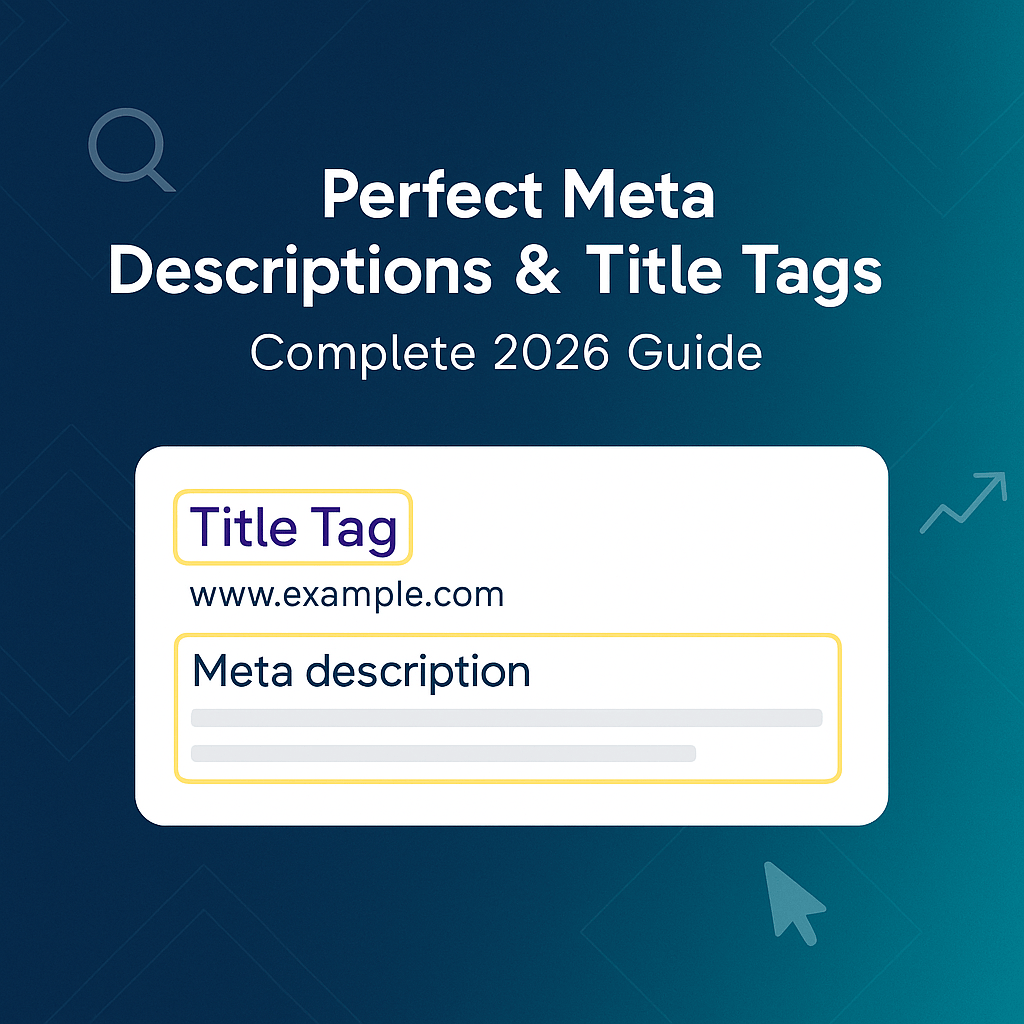
Before we get into optimizing strategies, let’s get an understanding of the elements that are involved and where they are located.
Title Tags are HTML elements that define the name of a website page. They are displayed as a clickable headlines on search engine result pages (SERPs) and in browser tabs. The code appears like this:
<title>Your Page Title Goes Here</title>Meta Descriptions are HTML attributes that provide a brief summary of a web page’s content. They typically appear below the title tag in search results. The code looks like this:
<meta name="description" content="Your page description goes here">Together, these elements form your search result snippet — the preview that users will see prior to making a decision on whether to visit your site. The title tag is given more weight, as it is one of the most important SEO ranking factors Both elements work in tandem to affect user behaviour and increase your rate of conversion.
Why Meta Descriptions and Title Tags Matter for SEO
Recognizing the importance of these components helps drive the effort needed to optimize them effectively.
The Role of Title Tags in Search Rankings
Title tags are a direct ranking signal to search engines. Google utilizes them to comprehend the content of your website and determine the relevancy of your site to queries. A well-optimized title tag
- Aids search engines categorize your content correctly
- Increases your chances of being ranked for your desired keywords.
- Enhances the visibility of results of searches
- Provides authority and relevance to the current topic.
Research has proven that websites with optimized keywords in their title tags have a tendency to rank higher than pages that do not. However keyword stuffing can hurt your rankings, therefore balancing is vital.
How Meta Descriptions Influence Click-Through Rate
Although meta descriptions do not directly affect rankings, they do have a significant impact on the likelihood that users click on your page. A compelling meta description:
- Provides context for your page’s content
- Sets expectations about what users can expect
- Differentiates your performance from your competitors
- It can include calls-to action that encourage clicks
Studies show that boosting your CTR can boost your rankings. If more people choose your site over others Search engines see this as a sign that your website’s content is relevant and valuable.
The Business Impact
The benefits of SEO go beyond SEO metrics:
- More organic traffic Better CTR equals more visitors, without any additional ad spending
- Leads that are qualified Clear descriptions entice the right people
- Reputation for brands Consistent, professional fragments of HTML0 help establish trust
- Competitive advantage to stand out among the crowded results of a search
The Anatomy of a Perfect Title Tag
A properly designed title tag is based on certain rules that balance SEO requirements and user-friendly appeal.
Title Tag Length: What’s Optimal?
Google typically shows the first 50-60 characters in the title tag. Anything beyond that is cut off by using an ellipsis (…). But, Google measures by pixel width, not by characters per character and therefore the limit can differ.
Best practice Maintain your title tags at 50-60 characters so that you can get full display on both desktops and mobile devices.
Example of Good Length:
SEO Copywriting Guide: 10 Tips to Boost Rankings(49 characters – displays fully)
Example of Too Long:
The Complete and Comprehensive SEO Copywriting Guide with Everything You Need to Know About Writing Content That Ranks(118 characters – gets cut off)
Essential Components of Effective Title Tags
Every strong title tag should include:
- Primary Keyword: Place it near the beginning when possible
- Value Proposition: What benefit does the page offer?
- Brand Name (optional): Include for homepage and key pages
- Unique Differentiator: What makes your content special?
Keyword Placement in Title Tags
The position of your keyword matters. Search engines give more weight to words appearing earlier in the title tag. Compare these examples:
Better: “Content Marketing Strategy: 15 Tactics for 2026” Weaker: “15 Tactics for 2026: A Content Marketing Strategy Guide”
The first example prioritizes the main keyword phrase, making it clearer what the page is about.
How to Write Title Tags That Get Clicks
The creation of title tags that work effectively requires understanding both the technical requirements as well as human psychology.
Formula 1: The Benefit-Driven Approach
Structure: [Primary Keyword] + [Benefit/Result]
Examples:
- “Email Marketing Tips That Increase Open Rates by 40%”
- “WordPress Security: Protect Your Site in 10 Minutes”
- “LinkedIn Profile Optimization: Get 5x More Connection Requests”
The formula is effective because it instantly announces what the user will benefit from.
Formula 2: The How-To Format
Structure: How to [Do Something] + [Optional: Qualifier]
Examples:
- “How to Write Blog Posts That Rank (Beginner-Friendly)”
- “How to Create Instagram Reels: Step-by-Step Guide”
- “How to Build Backlinks Without Outreach (7 Methods)”
How-to titles are extremely effective because they provide actionable advice.
Formula 3: The List/Number Approach
Structure: [Number] + [Keyword] + [Type of Content]
Examples:
- “21 Social Media Marketing Tools to Save Time in 2025”
- “7 E-commerce SEO Mistakes Killing Your Sales”
- “12 Productivity Apps for Remote Teams (December 2025)”
Numbers provide clarity and establish clear expectations regarding the format of the content.
Formula 4: The Question Format
Structure: [Question Your Audience Is Asking]
Examples:
- “What Is Conversion Rate Optimization? A Complete Guide”
- “Why Is My Website Not Ranking? 8 Common Problems”
- “When Should You Hire an SEO Agency?”
Questions-based titles are great for informational queries as well as the optimization of voice searches.
Power Words That Increase Clicks
Include these words that have been proven to make your title more memorable:
Action Words: Boost, Increase, Master, Discover, Unlock, Proven, Ultimate Urgency Words: Now, Today, Quick, Fast, Instant, Immediate Value Words: Free, Essential, Complete, Definitive, Best, Top Current Words: 2025, Latest, New, Updated, Modern, Current
Title Tag Best Practices Checklist
Incorporate your keyword naturally. Keep it to under 60 characters. Make it distinctive (no duplicate titles on pages) Write for human readers first, then search engines. Create realistic expectations for page content. Use powerful words strategically. Consider emotional appeal. Try different variations to determine what works best.
The Anatomy of a Perfect Meta Description
Although meta descriptions do not directly affect ranking, they’re essential for the purpose of attracting clicks from results of searches.
Character Limits and Technical Specifications
Google typically displays between 150 and 160 characters of meta descriptions on the desktop, and around 120 characters for mobile. Similar to title tags, meta descriptions are calculated by pixel width. Therefore, the exact number varies.
Best Practice Create meta descriptions between 150-160 characters to increase visibility while ensuring that your main message is displayed in full.
Mobile vs. Desktop Display Differences
With indexing for mobile first, it’s crucial to think about the way your meta descriptions display when you use smaller screen sizes:
- Mobile displays have fewer characters (approximately 120 characters))
- The most vital information should be included within the initial 120 characters
- Check your snippets of text on mobile and desktop
- Front-load your value proposition
Essential Elements of Compelling Meta Descriptions
Every effective meta description includes:
- Keywords to Target Use it naturally (Google bolds match terms)
- Clear Value Proposition What will users be able to learn or accomplish?
- Call-to-Action Inspire the click using action words
- Unique Selling Point Why should people do you prefer your page over other?
How to Write Meta Descriptions That Drive Traffic
Creating meta descriptions that convert searchers into visitors requires strategic thinking and persuasive writing.
Action-Oriented Language That Works
Start your meta description with strong action verbs that tell users exactly what they’ll do:
- “Learn how to…”
- “Discover the secrets…”
- “Get step-by-step instructions…”
- “Find out why…”
- “Master the art of…”
Example:
Discover how to write compelling meta descriptions that increase click-through rates by up to 30%. Includes examples, templates, and character limit guidelines.Writing for Users vs. Search Engines
The best meta descriptions serve both audiences simultaneously:
For Search Engines:
- Include target keywords naturally
- Stay within character limits
- Accurately reflect page content
- Maintain uniqueness across pages
For Users:
- Provide clear, compelling reasons to click
- Set accurate expectations
- Use conversational, readable language
- Create curiosity or urgency when appropriate
The AIDA Framework for Meta Descriptions
Apply this classic copywriting formula:
Attention: Grab interest with a hook Interest: Present relevant information Desire: Show the benefit or value Action: Include a soft call-to-action
Example:
Struggling with low organic traffic? Learn the 7 on-page SEO techniques that helped 500+ websites double their rankings in 2025. Complete guide with examples inside.Industry-Specific Meta Description Strategies
Different industries require different approaches:
E-commerce:
Shop premium leather wallets with RFID protection. Free shipping on orders over $50. 30-day money-back guarantee. 4.9/5 stars from 2,000+ reviews.Focus on: product benefits, offers, social proof, shipping/return policies
SaaS/Software:
Streamline your project management with intuitive software trusted by 10,000+ teams. Start your free 14-day trial—no credit card required.Focus on: benefits, social proof, free trial, ease of use
Local Business:
Award-winning Italian restaurant in downtown Chicago. Fresh pasta made daily, extensive wine list, romantic ambiance. Reserve your table today.Focus on: location, unique qualities, atmosphere, clear CTA
Blog/Content:
Learn advanced link building strategies that actually work in 2025. Step-by-step tutorial with real examples from successful campaigns.Focus on: value, currency, actionability, specificity
When to Include Your Brand Name
Include your brand name in meta descriptions when:
- You have strong brand recognition in your niche
- You’re targeting branded search queries
- Your brand adds credibility to the content
- Space allows without sacrificing key messaging
Example with brand:
HubSpot's complete guide to inbound marketing: attract, engage, and delight customers with proven strategies. Download free templates and resources.Common Meta Description Mistakes to Avoid
❌ Duplicate descriptions: Every page needs a unique meta description ❌ Keyword stuffing: “SEO tips SEO guide SEO help SEO best practices” ❌ Vague descriptions: “Welcome to our website where we provide services” ❌ Exceeding character limits: Important information gets cut off ❌ Missing call-to-action: No encouragement to click ❌ Misleading content: Description doesn’t match page content ❌ Too short: Wasting valuable space (aim for at least 120 characters)
Character Limits and Technical Specifications
Understanding the technical constraints helps you optimize within the boundaries.
Complete Character Limit Guide
Element	               Desktop	           Mobile	   Recommendation
Title Tag	       ~60 characters	 ~50 characters	   50-60 characters
Meta Description       ~160 characters	 ~120 characters   150-160 characters
What Happens When You Exceed Limits?
When your meta tags are too long:
- Google truncates them with an ellipsis (…)
- Critical information may be hidden
- Titles get cut off mid-sentence, looking unprofessional
- Users miss your key value proposition or CTA
Special Characters and Formatting
You can enhance your meta descriptions with special characters to stand out:
- Bullets: Use pipes (|) or dashes (-)
- Emoji: Use sparingly and only when brand-appropriate
- Symbols: ✓, →, •, ★ (test for compatibility)
Example with formatting:
Learn WordPress SEO in 2025 ✓ Step-by-step tutorials ✓ Free plugins ✓ Beginner-friendly guides. Start ranking higher today!Caution: Overuse of special characters can look spammy. Use them strategically.
Real Examples: Before and After
Seeing real transformations helps illustrate these principles in action.
Example 1: E-commerce Product Page
Before:
Title: Blue Running Shoes | Product Page
Description: Check out our blue running shoes. Available in different sizes.After:
Title: Men's Blue Running Shoes – Lightweight & Cushioned | Nike
Description: Experience ultimate comfort with Nike's blue running shoes. Breathable mesh, responsive cushioning, perfect for marathons. Free shipping & 60-day returns.
Why it’s better: Specific product details, brand name, benefits, and clear value propositions (free shipping, returns).
Example 2: Blog Post
Before:
Title: Content Marketing
Description: This article discusses content marketing and how to do it properly for your business.After:
Title: Content Marketing Strategy: 12 Steps to Drive Conversions
Description: Build a content marketing strategy that generates leads and sales in 2025. Learn audience research, content planning, distribution tactics, and ROI measurement.
Why it’s better: Specific number, clear benefit, comprehensive scope, actionable focus.
Example 3: Service Page
Before:
Title: SEO Services - Digital Marketing Agency
Description: We offer SEO services to help your website rank better in search engines.After:
Title: SEO Services That Increase Organic Traffic by 200%+
Description: Data-driven SEO services from certified experts. Technical audits, content optimization, and link building. 50+ clients achieved page 1 rankings. Free consultation.
Why it’s better: Specific results, credentials, service details, social proof, clear CTA.
Example 4: Local Business
Before:
Title: Joe's Plumbing
Description: Plumbing services in San Diego.After:
Title: Emergency Plumber San Diego | 24/7 Service | Joe's Plumbing
Description: Trusted emergency plumber in San Diego. 30+ years experience, licensed & insured. Water heaters, drain cleaning, pipe repair. Call now: (555) 123-4567.
Why it’s better: Location, key services, experience, credentials, emergency availability, phone number.
Common Mistakes to Avoid
Even experienced marketers can make these meta tag blunders that can affect performance.
Mistake #1: Using the Same Title Tag Formula Everywhere
The creation of unique, contextually appropriate titles for every page is crucial. Don’t use templates like:
- “Keyword | Brand Name” on every single page
- Generic formulas that do not differentiate the content
Solution: Create a custom title according to the page’s content and the intended use.
Mistake #2: Ignoring Search Intent
Your meta tags need to be in line with what the users are seeking.
An example of misalignment Keyword search “how to fix leaky faucet” Bad title: “Professional Plumbing Services | Faucet Repair Experts” Good title: “How to Fix a Leaky Faucet in 5 Steps (With Pictures)”
The first title is geared towards transactions (hiring someone) However, the query is geared towards an informational purpose (DIY guidelines).
Mistake #3: Forgetting About Mobile Users
With mobile-first indexing your meta tags need to be optimized for smaller screens.
Mobile Optimization Tips:
- Frontload key words and value propositions
- Check how your snippets of text appear on mobile devices.
- Keep titles even shorter (50 characters) for better mobile display
- Check that addresses and phone numbers are clickable
Mistake #4: Not Updating Old Meta Tags
As your content changes the meta tags you use should change too.
When should you update:
- Content has been extensively updated or expanded
- You’re targeting different keywords
- Your CTR is always low
- Your brand’s message has changed
- Updates on the season (add the current year)
Mistake #5: Keyword Cannibalization in Titles
Multiple pages that are competing with the same keyword can confuse search engines and decreases your potential for ranking.
Problem Example:
- Page 1: “Email Marketing Tips for Beginners”
- Page 2: “Email Marketing Tips: Complete Guide”
- Page 3: “Best Email Marketing Tips 2024”
Solution Make sure that each page is targeted with distinct keywords or subtopics.
Tools for Optimizing Your Meta Tags
Make use of these tools to streamline your process of optimization and monitor your performance.
Free Tools
1. Google Search Console
- Check CTR on each page.
- Look for pages with low views or clicks
- Check what queries trigger your pages
- Find opportunities to optimize
2. Yoast SEO (WordPress)
- Real-time previews of title and descriptions
- Character count tracking
- SEO analysis and suggestions
- Automated XML sitemap generation
3. Moz Title Tag Preview Tool
- Visualize the way titles appear in search results.
- Verify the width of the pixel.
- Test different variations quickly
4. SERP Simulator Tools
- See how your snippet will look
- Test on different devices
- Compare your performance to your competitors
- Adjust in real-time
5. Answer the Public
- Discover questions people ask
- Design titles based upon real-world queries
- Know the search intent better
Premium Tools
1. Ahrefs
- Analyze meta tags of competitors
- Track ranking changes after updates
- Find opportunities using keywords
- Review the entire site to find any issues
2. SEMrush
- Meta tag templates, suggestions and even a template
- On-page SEO checker
- Competitive analysis
- Tracking of the position
3. Screaming Frog SEO Spider
- Review all meta tags on your website
- Find duplicates and tags that are missing
- Export data for bulk optimization
- Find technical issues
Browser Extensions
1. SEO Meta in 1 Click
- Meta tags can be viewed on any page in a flash.
- Check the optimization of competitors.
- Verify the implementation
2. MozBar
- Fast access to page metrics
- Check out the title and description details.
- Analyze link profiles
Advanced Strategies and Pro Tips
Take your meta tag optimization to the next level with these advanced techniques.
A/B Testing Your Meta Tags
Yes, you can test different meta descriptions to see what drives higher CTR:
Method 1: Manual Testing
- Change your meta description
- Wait 2-4 weeks for data
- Compare CTR in Google Search Console
- Implement winning variation
Method 2: Using Google Ads
- Run ads with different headlines/descriptions
- Identify which messaging performs best
- Apply learnings to organic meta tags
Dynamic Meta Tags for Large Sites
If you manage hundreds or thousands of pages (e-commerce, directories), manually writing unique meta tags isn’t feasible.
Template Approach:
Title: [Product Name] - [Category] | [Brand]
Description: Shop [Product Name] at [Brand]. [Key Feature 1], [Key Feature 2], [Key Feature 3]. [Offer] + [Shipping Info].
Example Output:
Title: Sony WH-1000XM5 Headphones - Audio | BestBuy
Description: Shop Sony WH-1000XM5 Headphones at BestBuy. Industry-leading noise cancellation, 30-hour battery, premium comfort. Free shipping on orders $35+.
Structured Data Enhancement
While not part of meta tags, adding structured data can enhance your SERP appearance:
- Review stars: Product schema adds star ratings
- FAQ snippets: FAQ schema displays Q&A directly
- Breadcrumbs: Shows page hierarchy in results
- Event details: Date, time, location for events
- Recipe cards: Cook time, ratings, calories
These rich snippets work alongside your meta tags to create more compelling search results.
Optimizing for Featured Snippets
Structure your meta description to answer common questions concisely:
Question-Based Query: “What is SEO?” Meta Description Format:
SEO (Search Engine Optimization) is the practice of improving website visibility in organic search results. Learn the fundamentals, best practices, and latest strategies in our complete guide.The first sentence provides a direct answer, increasing chances of being pulled into a featured snippet.
Seasonal and Time-Sensitive Updates
Make sure your content is always fresh by ensuring that meta tags are updated regularly:
For Evergreen Content:
- Add the current year: “Ultimate Guide to Email Marketing (2025)”
- Updated information in the description: “…used by 12M+ companies in 2025”
For Seasonal Content:
- “Black Friday SEO Strategy: Prepare Your Site for 2025”
- “Summer Marketing Campaigns: 15 Ideas for June 2025”
Meta Tags for Different Page Types
Different page types require different meta tag strategies.
Homepage
Your homepage’s name and description should represent your company’s overall image image and your primary product.
Title Formula: [Brand Name] | [Primary Value Proposition]
Example:
Title: Mailchimp | Email Marketing Platform for Growing Businesses
Description: Build your brand and sell more with Mailchimp's email marketing platform. Easy-to-use tools for campaigns, automation, and analytics. Try free for 30 days.
Category/Archive Pages
Category pages should indicate the breadth of content while targeting broader keywords.
Example (Blog Category):
Title: Content Marketing Articles | Expert Tips & Strategies
Description: Explore 100+ content marketing articles covering strategy, creation, distribution, and measurement. Learn from industry experts and real case studies.
Product/Service Pages
Focus on specific benefits, features, and differentiators.
Example:
Title: Project Management Software for Remote Teams | Asana
Description: Coordinate work across distributed teams with Asana. Task tracking, timeline views, integrations with 200+ tools. 14-day free trial, no credit card required.
Blog Posts
Emphasize the value and actionability of your content.
Example:
Title: 17 Link Building Strategies That Work in 2024
Description: Master proven link building techniques that increase domain authority and rankings. Includes outreach templates, case studies, and step-by-step guides. Start building quality backlinks today.
About/Company Pages
Build trust and credibility while remaining discoverable.
Example:
Title: About ContentCo | Award-Winning Content Marketing Agency
Description: ContentCo is a full-service content marketing agency helping B2B brands scale growth. 50+ Fortune 500 clients, 200% average traffic increase. Meet our team and see our work.
Frequently Asked Questions
Does Google always use my meta description?
No. Google could alter your meta description as much as 70 percent often, removing the content from your website which is more relevant to the query. But having a well-written meta description can still influence:
- How do you ensure that Google comprehends your website
- What texts are accessible for rewriting?
- Display for brand-named and exact-match queries
Can I apply the same meta tag on different pages?
Absolutely no. Meta tags duplicates cause many issues:
- Search engines have difficulty distinguishing pages
- It is difficult to identify opportunities to target various keywords
- The users can’t distinguish pages in search results.
- Your website appears less professional and complete
Each page must have specific meta tags that are relevant and unique.
How long will it take to see the results after the meta tag update?
The typical time is typically, it takes between 2-4 weeks. The time frame is dependent on:
- How often Google crawls your website?
- Your website’s credibility and trust levels
- Competition in your niche
- If you want to request the re-indexing of your index
You can expedite the process by submitting your new URLs via Google Search Console.
Do I need to include my company’s name on the title tags of every item?
It all depends on your objectives and the brand’s recognition
Add brand name when:
- You’re a brand with strong name recognition
- It’s your homepage or the most important landing pages.
- You’re aiming for branded search results
- It increases trust and credibility.
Do not use mark when:
- The character space is limited and the value prop is more crucial
- Your site is targeting extremely competitive, non-branded keywords
- Your brand isn’t well known and occupies valuable space
What happens if Google displays a different title than the one I have created?
Google changes the title tags on around 60% of its results. This occurs when:
- Your title is too long, or too short.
- It’s full of keywords
- It doesn’t match the query.
- Your H1 tag should be more in line with the intention of the user
Solution Create precise, descriptive, and accurate titles that match the content of your pages and H1 tags.
Are emojis included in meta tags able to aid or harm SEO?
Emojis have no direct impact on rankings, but they can impact CTR
Potential Benefits:
- Be noticed in the search results
- Improve the visually appealing
- Improve CTR for lifestyle/consumer brands
Potential Drawbacks:
- Could look unprofessional if used in corporate/B2B
- It may not render correctly on certain devices.
- Google could remove them
Make sure you test emojis that are appropriate for your target market and industry.
Do meta keywords tags still matter?
No. Google has officially ended the use of meta keywords in 2009 due to the widespread misuse. Make sure you focus your efforts on title tag and meta description.
Step-by-Step Implementation Checklist
Utilize this checklist to improve meta tags on your site consistently.
Phase 1: Audit (Week 1)
• Export all current meta tags and title tags descriptions. # Identify pages that have meta tags that are duplicates. pages lacking meta tags Verify the length of characters across all pages. information within Google Search Console # Analyze the meta tags of your competitors for the most popular pages
Phase 2: Strategy (Week 2)
Prioritize pages according to potential traffic (start with the highest) * Research the keywords that are most relevant for each page. the intent behind searches on priority pages Make templates for similar types of pages Create guidelines for the brand voice for meta-content
Phase 3: Optimization (Weeks 3-6)
Create distinctive title tags for your priority pages. Create captivating meta descriptions for your pages # Make sure to include that you include keywords and have the proper length. # Include the CTAs as well as value-propositions Make changes to your CMS. both on desktop and mobile devices.
Phase 4: Testing & Monitoring (Ongoing)
Request re-indexing to reflect the latest pages. Monitor changes in CTR in Search Console. Track rankings movements # Test A/B variations on pages of importance # Update according to performance data Create a quarterly review schedule
Final Thoughts: Making Meta Tags Work for Your Business
Meta description and title tags are one of the best leverage SEO optimizations you can implement. In contrast to changes in SEO which require developer resources or the creation of content that requires a an investment of time the meta tag optimization process is:
- Simple to implement It is possible to optimize many pages in a matter of hours
- low risk The changes can be reversed easily if they are needed.
- Impactful direct effect on CTR and the acquisition of users
- Cost-effective It requires only time and a strategic approach
The trick is to approach this task strategically, not mechanically. Do not just cram keyword phrases into your templates. Instead:
- Learn about your target audience What is their language of choice?
- Be aware of your competitors What are the other competitors in your industry doing?
- Test and repeat Use the information to make improvements
- Keep up-to-date Make sure to update regularly as strategies and content evolve
- Consider the whole picture Meta tags are a part of a bigger user experience
Remember that these tags are essentially advertisements for your website’s content. Every search result offers an chance to convince someone that your website is worth their time over the other 9 alternatives that are available.
Make the effort to write appealing, accurate, and benefit-driven meta tags and you’ll see significant improvements in organic traffic as well as user engagement.