On-page SEO is the basis of any successful strategy for optimizing your search engine. No matter how great your content is but if your on-page SEO elements aren’t optimized properly to get higher Google rankings becomes a challenge. This is true for business owners, bloggers, and digital marketers too.
Based on real-time SEO reviews and real-world rankings research It is evident that Google is no longer focused solely on keywords. Instead, it focuses on the quality of content, its relevance as well as user experience. This is the reason on-page SEO optimization has become more crucial in 2026 and beyond.
In this comprehensive guide, you’ll be taught about 15 critical on-page SEO elements that aid search engines comprehend the content you post and rank it higher. If these elements are optimized properly they will not only boost rankings, but also aid in building long-term organic traffic as well as trust with users.
This SEO guide was designed to be practical, attainable and appropriate for novices as well as experienced SEO experts.
What is On-Page SEO?
On-page SEO is the process of optimizing elements of a website that are entirely within your own control. It includes the elements like content, HTML tags, internal links images, as well as the overall structure of your page all of which aid in helping search engines to understand what your site is about.
In a simple way, on-page SEO optimization informs Google how relevant your site is to a particular user’s search and how it is in line with the intent of the user. When elements like title tags, headings and URLs, and other content are properly optimized and properly, search engines will be able to evaluate and rank your site more precisely.
On-page SEO can be confused with off-page SEO or technical SEO. However, its primary emphasis is quality of content, current relevance as well as user experience which are crucial to sustain long-term and sustainable rankings in search results.
The Reason On-Page SEO is Essential for Faster Rankings
On-page SEO is crucial because it gives search engines clear and well-structured signals about your content. If Google crawls a webpage it’s primary objective is to comprehend the content of the webpage and decide if it meets the user’s intention. This is the point where on-page SEO factors play a significant role.
Optimizing title tags, headings, and other content assists search engines to quickly determine the significance of a web page. This means that indexing is faster and the process of ranking gets increased. This is the reason why an effective SEO optimization on the web frequently results in faster rankings particularly for keywords that are competitive.
Furthermore, on-page SEO greatly enhances user experience. A well-structured, simple-to-read and useful content can encourage users to stay on the page. Positive engagement signals show the quality of content and trustworthiness and help ensure long-term ranking stability.
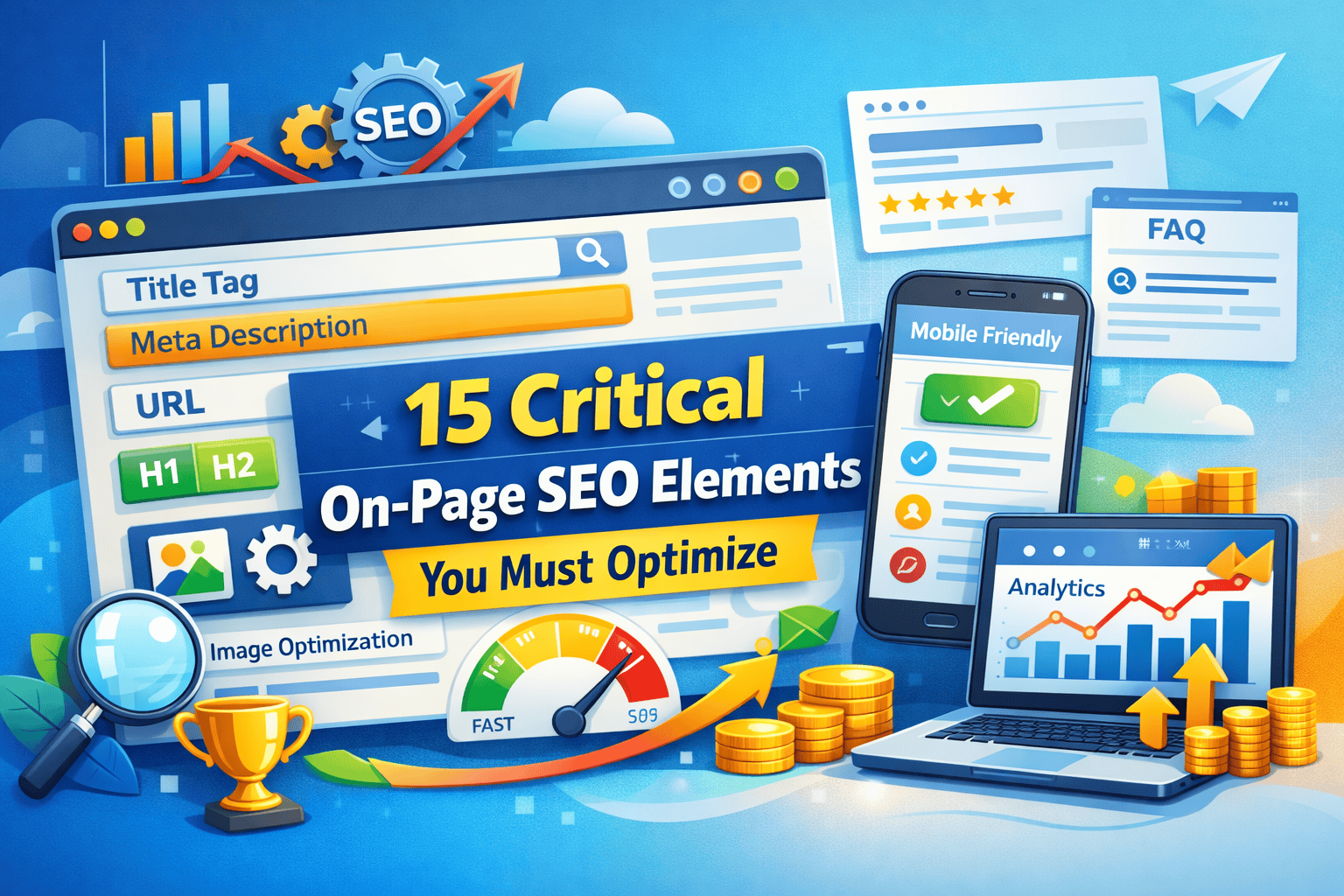
15 Critical On-Page SEO Elements You Must Optimize
Optimizing your on-page SEO isn’t just about implementing random strategies. It’s about enhancing the correct elements that directly affect how search engines view your content as well as how users engage with your content. Every element on a page sends signals to Google in regards to the quality of content, its relevance and the user experience.
The 15 crucial SEO on-page elements that are listed below are based on established techniques for SEO, real-world optimization experience and how the latest algorithms assess web pages. Once these aspects are well-optimized they increase crawlability, improve the relevancy of your site, and improve the chance of being found faster on search engine results.
It is crucial to remember that on-page SEO is most effective when all elements are in sync with the intent of search and deliver an actual benefit to users. If you do not consider even one of these elements can reduce your website’s potential for ranking especially in niches with high competition.
Let’s break down each aspect in detail to learn the best way to use it properly.
3. SEO-Friendly URL Structure
An SEO-friendly URL helps both users and search engines understand what a page is about before even visiting it. Clean and descriptive URLs improve readability, increase trust, and support overall on-page SEO optimization.
A good URL should be short, keyword-focused, and free from unnecessary numbers or symbols. Use hyphens to separate words and include the primary keyword naturally. For example, a URL like /on-page-seo-elements/ is far more effective than a long, confusing URL with random parameters.
Avoid changing URLs frequently, as this can affect existing rankings and backlinks. Once set correctly, a well-structured URL improves crawlability and contributes to better search visibility over time. Simple URL structures also make it easier for users to remember and share your content.
1. Title Tag Optimization
It is considered to be one of the most vital SEO on-page elements since it directly affects the search engine rankings as well as click-through rates. It’s the first thing people are presented with on search results pages, making it a crucial element in getting organic clicks.
To optimize your title tag Keep the length of your title tag within 50-60 characters so that it will display correctly when you search for it. Make sure to place your main keyword naturally towards the beginning of the title. This is while making sure that it is still clear for the user. Avoid keyword stuffing because it could affect readability and reduce confidence.
A properly-optimized title tag must clearly explain the content and also highlight the benefits or solution. If done properly it increases the relevance signals to search engines and draws users to click on the page, which results in faster and more stable ranking.
2. Meta Description Optimization to Increase CTR
Meta descriptions might not be a factor in ranking however they play a significant function in boosting click-through rates for search results. An appropriately written meta description can encourage people to visit your site, which in turn helps improve the performance of your SEO on-page optimization.
The ideal meta description should comprise between 150 to 160 words and clearly describe what the users are likely to get from the site. Include your primary keyword or secondary keyword naturally, but you should focus on clarity and relevance instead of keyword placement. Making use of action-oriented language, and highlighting a specific benefit will significantly increase engagement.
Avoid duplicating meta descriptions across multiple pages. Each page must be unique in its description, which corresponds to the intent of search and accurately reflects the information. If visitors find your website appealing at first glance users are likely to visit on it and remain in the page, sending favorable signals to the search engine.
4. Properly Using H1, H2 and H3 Headings
Heading tags can help you structure information in a manner that is simple for search engines and users to comprehend. Making usage in the form of H1, H2, and H3 headings enhances the readability of your content and increases the SEO signals on your page.
Each page should contain just the one H1 tag that clearly defines the primary subject matter of the page and incorporates the main keyword naturally. H2 tags are best utilized for the main sections, and H3 tags aid in breaking sections into logical flow. This hierarchical structure can help search engines comprehend the context and significance the content.
Optimized headings can improve the user experience by making information easily accessible. If users are able to quickly locate the information they’re looking for, their engagement increases and this leads to better ranking over time.
5. High-Quality, Helpful Content (EEAT Core)
Good-quality, useful content is the basis of a successful SEO on-page. Google’s algorithm is designed to recognize content which shows experience, expertise, authority, and trust (EEAT) while genuinely solving the problems of users.
In order to create content that is SEO-friendly be sure to provide complete, accurate and up-to-date content that is based on actual experiences or knowledge. The content should be more than superficial explanations and should include clear insight and examples or concrete steps that readers can implement. This method increases credibility and increases the relevance of the topic.
In addition it is important to write content to be read by humans and not only for search engines. Utilize simple language, brief paragraphs as well as a consistent flow to increase accessibility. If users feel your content is helpful and reliable, they are more likely to stay and are more engaged. They also will be more inclined to revisit -in turn, sending positive quality signals that lead to better rankings.
6. Keyword Positioning and Density Optimization
A proper placement of keywords helps search engines comprehend the primary subject of your article without compromising accessibility. Effective keyword optimization does not require repetition it’s about placing keywords in the right places to can add value to the content.
Your main keyword should be included in important areas like the title tag H1 heading, the introduction, some subheadings that are relevant, and finally in the conclusion. Keywords that are related to secondary ones should be naturally distributed throughout the text to ensure relevancy. Do not focus on a specific keyword density, since this could result in unnatural writing.
Instead, you should focus on the clarity of your content and the user’s intent. If keywords are utilized in a natural, conversational style your content will be more readable and simpler to understand. This method of balancing minimizes the chance of over-optimization, while enhancing your overall SEO signals.
7. Search Intent Optimization
Optimizing and understanding the search intent is an essential SEO component on the web. Every query that a user type into Google serves a specific goal: navigational, informational or transactional. Making sure your content is aligned with the proper intent makes sure that the users get exactly what they’re looking to improve engagement and ranking.
To make your site more search-friendly look at the top-ranked pages on your targeted keyword. Find out what type of content Google prefers whether it’s a thorough outline, listicle or a page for a productand then structure your site to reflect that. Be sure that headings as well as meta descriptions and content clearly reflect the purpose.
Content that is relevant to search-related intent can lead to a longer time of stay more bounces, less bounces, and higher satisfaction of users. Positive user signals indicate to the search engines that your site is trustworthy and relevant.
8. Internal Linking Strategy
Internal linking can be described as an important SEO on-page factor that assists crawlers index and crawl your site in a timely manner. It also helps users find relevant content, which increases engagement and the time spent on your site.
A solid internal linking strategy is to link relevant pages by using anchor text that defines the content in a clear manner. Avoid using generic terms such as “click here” instead, utilize natural keywords that are descriptive and also enhances the site’s relevancy.
Internal links also distribute the link equity throughout your site increasing the authority of more important pages that do not contain external backlinks. Monitoring and regularly updating internal links makes sure that your important pages remain accessible and optimized for search engine potential.
If properly executed If done properly, internal linking can improve the user experience as well as the performance of SEO which results in faster indexing and better rankings.
9. Image Optimization (Alt Text and Size)
Images can make content more interesting however, if they are not optimized properly they could cause slowdowns on your site and adversely affect on-page search engine optimization (SEO). Optimizing images requires the reduction of the size of your files and making use of specific alt texts and incorporating appropriate keywords automatically.
Alt text assists search engines comprehend the meaning of the image, increasing access and enhancing the likelihood of being featured when searching for images in Google Image Search. The size of the file should be reduced without compromising the quality of the image to increase the speed of loading a page as this is a crucial ranking aspect.
Furthermore the use of well-organized image naming conventions as well as responsive images that work on different devices enhance the user experience. Correctly optimized images help with the SEO performance as well as interaction with users which makes your content look more professional and user-friendly.
10. Page Loading Speed
Speed of loading pages is an essential SEO element on the page as slow websites negatively impact the user experience and may affect rankings. Google is adamant that speed of page loading is one of their Core Web Vitals, making it a crucial factor for both mobile and desktop users.
To improve page speed compress images, make use of browser caching, reduce JavaScript and CSS and make use of a content delivery system (CDN). Furthermore, removing unnecessary plugins and reducing server response time will significantly speed up load times.
Speedy loading pages decrease bounce rates, boost the engagement of users, and also inspire visitors to visit more of your content. When you prioritize speed, you do not just enhance SEO signals but give your visitors a smoother, more professional experience that increases confidence and trust with your customers.
14. Outbound Links to Authoritative Sources
Linking to reputable, authoritative websites is a subtle but powerful on-page SEO factor. Outbound links help search engines understand the context of your content and show that you reference credible sources, which enhances your EEAT (Expertise, Authority, Trustworthiness).
When adding outbound links, ensure they are relevant to your topic and provide additional value to users. Use descriptive anchor text naturally, and avoid linking excessively to low-quality or spammy sites. Linking to recognized publications, official resources, or industry leaders strengthens your content’s credibility.
Properly implemented outbound links not only boost your authority but also improve user experience by directing visitors to additional resources. Combined with internal linking, this strategy helps search engines see your website as a trustworthy and reliable source of information.
11. Mobile-Friendliness
In the wake of Google’s mobile-first indexing mobile-friendly has become an essential on-page SEO eleme. A responsive website makes sure that your content is displayed properly across every device, ensuring an optimum experience for mobile users.
The key elements of mobile optimization are responsive design with legible fonts, easy-to tap buttons, and pages that load quickly. Testing your website with tools such as Google’s Mobile-Friendly Test can help you identify any issues that could impact usability and ranking.
Mobile-friendly websites not only improve the user experience but can also positively impact SEO signals like bounce rate and dwell time. Making sure your site is functioning properly for users on mobile devices is vital to reach a wider public and achieving better ranking in the search results by 2026.
12. User Experience (UX) Signals
User experience plays an important role in on-page SEO since it directly impacts the metrics of engagement like bounce rate as well as dwell time and the number of pages per session. Google takes positive UX signals as a signal that your page’s content is relevant and valuable.
To improve UX to improve UX, make sure your content is simple to read, with concise headlines, bullet points as well as short paragraphs. Pages that load quickly, easy navigation, and mobile-responsiveness are also essential to seamless user experience. Incorporating multimedia such as videos, images, or infographics can make content more interesting.
By prioritizing UX You not only keep visitors longer, but also send powerful signals to search engines regarding the content’s quality. Combining usability with relevancy improves rankings and overall credibility of your site.
13. Schema Markup (Structured Data)
Schema markup, also known as structured data is a crucial SEO element on the page that assists search engines to understand the context of your content. Schema markup can improve your search results by providing rich snippets of information like reviews, FAQs ratings, and information about an event.
Structured data is not able to directly increase ranking, however it does improve the click-through rate (CTR) and can improve visibility. The most common types of schema are FAQ, Article HowTo, Product and LocalBusiness. Tools such as Google’s Structured Data Testing Tool can be used to validate your schema.
By providing clear details, schema markup increases your site’s authority and credibility. When paired with other SEO elements on-page that support EEAT signals and increases the chances of getting specifically targeted organic traffic.
15. Content Freshness and Updates
Maintaining your content current is a crucial SEO element on the page, particularly for topics that change over time. Google prefers pages that contain current relevant and accurate information. This can help improve the stability of your rankings and ensure trust for users.
Regularly updating content with new information and correcting outdated information, ensures your content is dependable. Even minor changes like updating statistics including internal links or adding examples, signal to search engines that the website is regularly maintained.
Fresh content also improves user experience, since visitors more likely to trust and interact with information that is current. Continuous updates in conjunction with other on-page SEO elements enhances the overall EEAT signals and helps improve rankings in search results.
On-Page SEO Checklist
Here’s a concise checklist to ensure your website’s on-page SEO is fully optimized:
- ✅ Title Tags: Include primary keywords naturally, keep within 50–60 characters.
- ✅ Meta Descriptions: Clear, action-oriented, 150–160 characters, unique for each page.
- ✅ SEO-Friendly URLs: Short, descriptive, keyword-focused.
- ✅ Headings (H1-H3): Proper hierarchical structure with relevant keywords.
- ✅ High-Quality Content: Helpful, original, EEAT-driven, and engaging.
- ✅ Keyword Placement: Primary and secondary keywords used naturally.
- ✅ Search Intent Alignment: Match content type to user intent.
- ✅ Internal Linking: Relevant anchor text to other pages.
- ✅ Image Optimization: Alt text, size, and responsive images.
- ✅ Page Speed: Fast loading on all devices.
- ✅ Mobile-Friendly: Responsive design and easy navigation.
- ✅ UX Signals: Readable content, intuitive layout, positive engagement.
- ✅ Schema Markup: Structured data for rich results.
- ✅ Outbound Links: Credible sources for authority.
- ✅ Content Freshness: Regular updates to maintain relevance.
Use this checklist to audit your pages regularly and ensure they comply with modern on-page SEO standards.
Common On-Page SEO Mistakes
Even experienced website owners can make on-page SEO errors that limit ranking potential. Here are the most common mistakes to avoid:
- ❌ Keyword Stuffing: Overusing keywords reduces readability and may trigger penalties.
- ❌ Duplicate Content: Repeating content across pages dilutes authority and confuses search engines.
- ❌ Ignoring User Experience: Long paragraphs, poor navigation, or slow pages frustrate visitors.
- ❌ Missing Meta Tags: Lack of optimized title tags and meta descriptions reduces CTR.
- ❌ Broken Links: Internal or outbound broken links hurt user experience and crawlability.
- ❌ Unoptimized Images: Large, slow-loading images or missing alt text impact speed and accessibility.
- ❌ Neglecting Mobile Optimization: Non-responsive design harms rankings and user engagement.
Regular audits and following the checklist from the previous section can prevent these errors and ensure your pages remain search-engine friendly.
FAQ’s for on-page SEO element
What is the most crucial SEO on-page element?
The most crucial SEO on-page factor is high-quality content that is in line with the user’s expectations. It must be well-structured and informative, and incorporate relevant keywords naturally while offering real value for users. Other elements like headings, title tags and URLs help to ensure the content’s relevance.
What is the best time to refresh my SEO on-page?
On-page SEO must be reviewed frequently, at least every 3 to 6 months. The updating of content as well as refreshing statistics, optimizing meta tags, and examining internal links ensures that your pages are pertinent and relevant in search results.
Does on-page SEO have enough to get you ranked?
Although on-page SEO is important however, it is best it is paired with off-page SEO such as backlinks and social signals, as well as technical SEO elements like speedy loading speeds, mobile-friendly and secure sites.
How do I improve my images to be SEO friendly?
Utilize explicit alt texts compress images to speed up loading, and add keywords naturally, if they are relevant. Optimized images improve the user experience, and improve accessibility, and could be displayed in Google Image Search results.
What are the most common SEO mistakes that you can avoid?
Avoid keyword stuffing duplicate content, slow loading pages broken meta tags, broken links and poor mobile-optimization. Regular audits can help maintain SEO-friendly pages.