Introduction: What Are SEO Ranking Factors and Why They Matter
If you type in a search term on Google Have been wondering why some websites rank on the first page while others are hidden on the fifth page? The answer is in the so-called SEO ranking factors. call SEO rankings factors. These are the signals Google employs to determine which sites are worthy to be ranked more highly in search results.
Google’s algorithm employs more than 200 ranking factors to determine the order of the results of a search. However, different ranking factors do not carry the same importance. Some are essential and others play an insignificant part. Understanding the most significant ranking factors and the way they operate is crucial if you want your site to gain search engine rankings on Google.
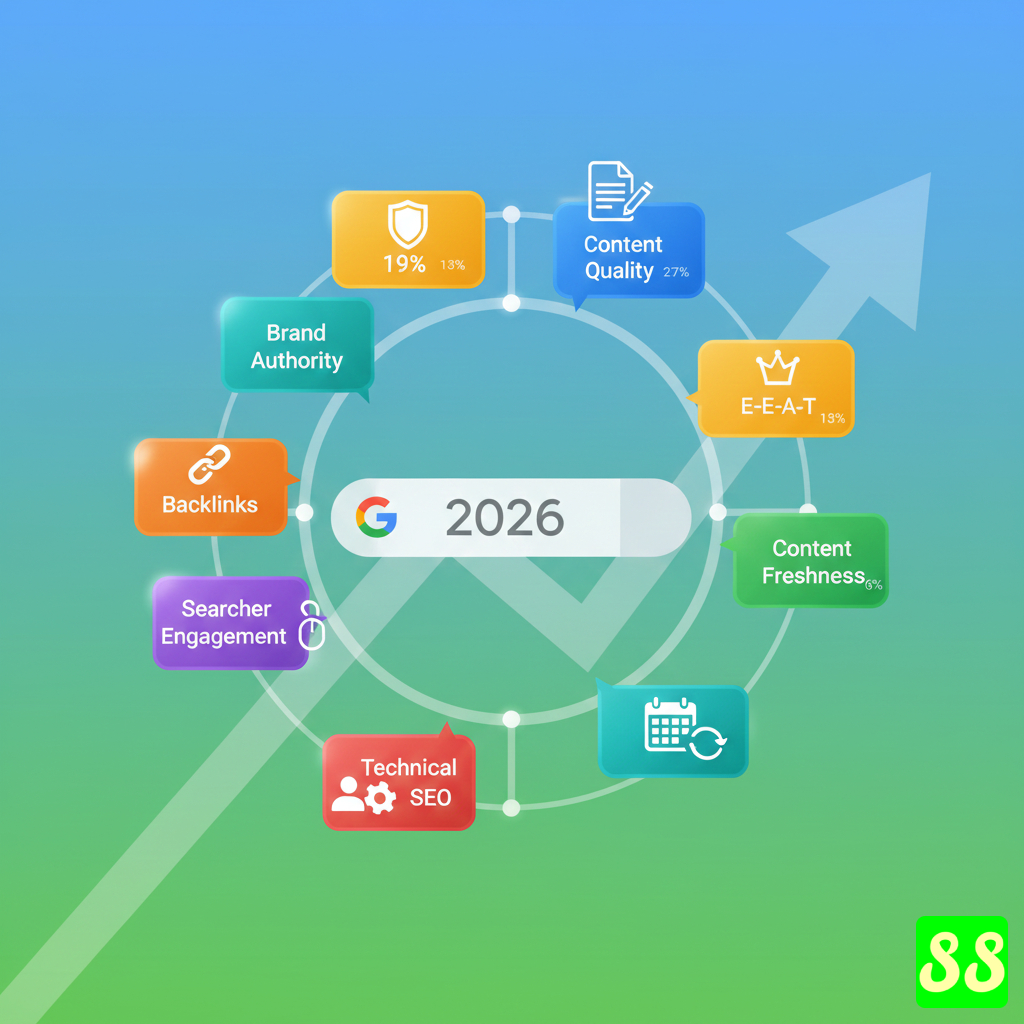
In 2026 the nature of factors that influence rankings has changed dramatically. Google has shifted the importance they attach to various aspects. Freshness of content has become more important than ever. Engagement signals from searchers now make up a greater percentage of your ranking. Diverse distribution of links is being acknowledged as a crucial ranking factor. Brand authority plays an increasingly important part in determining which websites are ranked at the top.
This complete guide will take you through the most important SEO ranking factors that are important in 2026. It will explain not only the factors that affect these rankings but also how to optimize your site. If you’re focused on the factors that affect on-page rankings or off-page ranking factors as well as technical factors for ranking, this book will explain all you need to know about.
The Top 5 Most Important Ranking Factors Google Prioritizes in 2026
All SEO ranking factors are all created to be equal. Certain factors have more influence on your search engine rankings than others. If you’re looking to increase your site’s visibility, you have to concentrate your efforts on elements that are most important.
1. Consistent Publication of Satisfying Content (27% Weight)
The most important ranking factor in 2026 is to create consistently high-quality, consistent content that meets the needs of users are looking for. This makes up around 27% of your total ranking power, which is the most important factor to be focused on.
What is “satisfying content” mean? It’s content that answers the user’s query. It’s about going above and beyond the surface information and providing genuine depth and understanding. When a person searches to find information, they’re searching to find answers that are comprehensive and precise, as well as useful.
In 2026, Google has become even more adept at separating between content that actually serves the user, and content that is just trying to get a position on the search results for keywords. The search engine analyzes the signals of engagement and user behavior to determine whether your content is actually satisfying those who came across it.
This is the reason why consistency in publication comes into. You can’t write a amazing article and expect to continue being ranked for eternity. Google recognizes websites that release regular updates and regularly update their existing content regularly. Google’s algorithm rewards websites that demonstrate they are committed to their subject and keep their information up-to-date.
2. Searcher Engagement and User Satisfaction (12% Weight)
When someone clicks your result on Google the next step is crucially important. Do they take time to read your blog or do they click back to Google immediately? Do they visit different pages on your site or simply browse one page and then leave?
Searcher engagement signals make up the equivalent of 12% of the ranking factors by 2026, which makes it the second-most important factor to concentrate on. Google analyzes this by using several important metrics:
Click-through rate (CTR) is how often people click on the search result they come across it. If your description and title are appealing and compelling, more users will click. This is a powerful message to Google that your page is relevant.
Dwell time is the amount of time a user stays on your website before re-entering Google results. The longer they remain on your page, the more beneficial. This means that your article was actually useful.
Bounce rate indicates the percentage of visitors leave your website without taking further action. If you have a high bounce rate, it could suggest that your website’s content did not satisfy expectations.
Pages per Session indicates the number of pages that a user visits on your site. If they’re looking at several pages, they’re likely to be more engaged by your website’s content.
These engagement indicators are a part of the concept that Google is calling “user satisfaction.” Google is basically asking “Did this user find what they were looking for?” If yes, then that’s an extremely powerful ranking signal.
3. Niche Expertise and Topical Authority (13% Weight)
Expertise in your area of expertise is more important in 2026 than ever before. Google is looking to rank websites with deep expertise and authority in their area of expertise. This is a portion of 13 percent of the factors that determine your ranking.
What is a niche expert? It’s when you specialize in an industry or subject and are recognized as an expert in the field. Instead of covering all the information regarding digital marketing, you could focus on SEO specifically for online stores. Instead of providing general advice to businesses, you may concentrate on marketing for law firms.
Google can tell if an online site is specialized in a particular field. It considers factors such as:
- How thoroughly do you’ve covered your topic?
- If you regularly post content on this specific subject
- If you have experts from your field connect to and reference your work
- Author credentials and background information
- If your site is renowned for this particular subject
That’s where the idea of authority in the topic comes into play. If you can establish topical authority — which means you have a wealth of content covering the entirety of your subject matter, Google will give you higher rankings.
4. Quality Backlinks and Link Profile Diversity (13% Weight)
Links are among the main ranking factors accounting for 13% of your total ranking power by 2026. However, it’s not all about the number of backlinks you own. The quality and variety of your backlinks is crucial.
A backlink is when a website connects to your site. Consider it an affirmation of your credibility. When a website with a high authority connects to you it signals Google that your website is worthy of linking to.
But here’s the crucial part that not all backlinks are created equal. A link from a highly well-known, authoritative authority site is worth greater than 100 links on spammy websites. In fact, having too many low-quality backlinks could harm your rankings.
Diverse distribution of links is becoming increasingly important. This means you need backlinks that come from different sources, rather than obtaining every link from a single type of site. Links from directories that are high-authority, industry publications and news websites, as well as other sources that are relevant is more effective than obtaining every link from a single type of source.
5. Content Freshness and Regular Updates (6% Weight)
One of the most significant changes to come in 2026 is the increase in the freshness of content as an important ranking factor. It is now a factor that accounts for 6 percent of your rankings which is up from just 1% one year ago. This is a major shift in the way Google evaluates its ranking factors.
Fresh content doesn’t mean that you have to rewrite every day. It’s about keeping your content current and up-to date. If you wrote an article 3 years ago on the top digital marketing tools you must keep it up-to-date with the most recent techniques and data.
Sites that refresh their content at least every year get an average increase of 4.6 positions on Google. This is a significant boost that could be attributed to keeping your content current.
What does freshness mean in real life? It could refer to:
- Data and statistics that are up-to-date with the most current numbers
- New sections are added to the site on recent developments
- Correcting information that is outdated
- The general quality of an article
- Incorporating cases or examples
- Images and screenshots that are refreshed
Understanding On-Page Ranking Factors in 2026
The On-Page Ranking Factors are elements of your website which you are able to control directly. They encompass the entire spectrum of things from title tags, your content’s quality to internal hyperlinks. Understanding these factors on the page ranking is crucial to improve search engine optimization.
Title Tags and Meta Descriptions
It’s the title of your page you see on Google result pages. It’s among the first things people will see and has a significant impact on the decision of whether they click on your results or simply ignore it.
For purposes of ranking Your title tag should:
- Include your principal keyword naturally
- You should use between 50-60 characters in order to ensure that you don’t get cut off from the results of your search.
- Make sure your content is compelling and click-worthy.
- Be precise in describing what’s on the page.
Meta description is a brief description that appears under your title tag on search results. Although it does not directly affect ranking, it can significantly impact the click-through rate. Meta descriptions that are well written could boost clicks by 30 percent or more.
Limit your meta description to 150-160 characters. Include the primary keyword naturally. It should be compelling enough to make the reader would want to find out more.
Keyword Relevance and Placement
Your keywords should be prominently displayed in your content. This will help Google know what your page is about. It is best to use your primary keyword on your page:
- In the H1 heading of your account
- The first 100 lines of your article
- In at least 3 headings (H2 and H3)
- Naturally, throughout the body content
The aim is natural integration of keywords, not overfilling. The keyword density must be between 1-2 percent. If your article contains 4000 words, the principal keyword should be used 40 to 80 times in the content naturally.
However, don’t just repeat your main keyword in a series of times. Use variations and other related phrases. That’s where the long-tail keywords as well as LSI keywords can be found. These keywords assist Google to understand the complete meaning of your subject.
Header Tag Structure (H1, H2, H3)
The structure of your header tag is essential for SEO and for readability. The H1 tag should be displayed only one time per page and must contain your main keyword. Consider it to be the text of your post.
The H2 tag is a subheading which split the content up into more logical parts. They must contain keywords that are related to and variations of your main keyword. H3 tags are sub-subheadings used to arrange content in H2 sections.
This hierarchical structure aids Google recognize the organization of your content and enhances the readability of users.
Image Optimization and Alt Text
Images can make your content more interesting, however search engines don’t “see” images the way humans do. This is what alt-text is essential. Alt text must be:
- Explain what the image depicts
- Naturally include keywords when appropriate.
- Be concise but descriptive
- Do not be keyword-stuffed
Image alt text can help with accessibility as well as SEO of visually impaired people. It’s a win-win.
Internal Linking Strategy
Internal links are hyperlinks that connect the same page on your website to a different page on your site. They are used for a variety of reasons:
- They distribute authority across your website
- They assist Google recognize the structure of your site
- Visitors stay to your website longer
- They provide relevance to the current moment.
When you link internally, make sure to make sure to use descriptive anchor text with relevant keywords. For instance, instead of “click here,” use “learn more about SEO ranking factors.”
Technical SEO Ranking Factors That Impact Your Search Visibility
Ranking factors for technical SEO are the fundamental elements that enable Google to crawl and index your website correctly. If you’re having issues with your SEO’s technical aspects even the most compelling content may not be able to rank well.
Core Web Vitals and Page Experience Signals
Core Web Vitals are Google’s method to measure the user experience on your site. They are comprised of three important metrics:
Largest Contentful Paint (LCP) measures how the main content on your website loads. Try to get LCP less than 2.5 seconds. This is important because people are expecting websites to load fast.
Cumulative Layout Shift (CLS) measures visual stability. When you’re reading a webpage it can be annoying when elements suddenly shift. Make sure to keep your CLS score under 0.1 to prevent this issue.
Interaction to Next Paint (INP) is the most recent metric available in Core Web Vitals. It is a measure of the responsiveness of your site to user interactions such as taps and clicks. Try to keep INP less than 200 milliseconds.
All of these elements make up the what Google is calling “page experience signals.” Pages with a positive experience have higher rankings than sites that have a poor user experience.
Mobile Responsiveness and Mobile-First Indexing
More than 60% of searches occur through mobile devices. Google acknowledges this and employs mobile-first indexing. This means that they search and index the mobile version of your site.
Your website must contain:
- Highly responsive across all devices sizes
- Mobile connections are fast and reliable
- Text that is readable without zooming
- Have buttons that are properly sized and links
- Free of annoying pop-ups
Mobile optimization isn’t a choice, it’s a necessity to rank well in 2026.
Website Speed and Page Load Optimization
Fast websites rank higher than slow ones. Google verified page speed as a ranking element and users do prefer fast websites.
To improve your website speed:
- Enable caching for your browser
- Compress images without sacrificing quality
- Minify CSS and JavaScript
- Use a Content Delivery Network (CDN)
- Select a good hosting provider
- Remove any unnecessary plugins or code
- Lazy loading images are below the fold
Utilize tools like Google PageSpeed Insights for identifying speed issues on your website.
HTTPS Security and SSL Certificate
An SSL certificate encrypts data that is exchanged between your site and visitors. It’s identified with “HTTPS” in your URL and a lock icon within the browser. Google considers HTTPS an important ranking factor as well as a security signal.
Installation of an SSL certificate is now a common practice. The majority of hosting providers offer free SSL certificates and there’s no reason to not have one.
XML Sitemap and Robots.txt Optimization
A XML sitemap is a document that lists all the most important pages on your site. It assists Google to discover and crawl your entire website efficiently. Upload your sitemap to Google Search Console to ensure Google is aware of every page of your site.
Your robots.txt file informs crawlers of search engines which pages they can visit. A optimized robots.txt:
- Lets you crawl important pages
- Blocks low-value pages
- Prevents budget waste that is crawling
- Points to your XML sitemap
Schema Markup and Structured Data
Schema markup can help search engines better understand your content. It provides context to your content, products reviews, and other content. Schema markup implementation can result in rich snippets of content in search results, which can increase click-through rates.
For blog articles, use Article schema. For FAQ sections, use FAQPage schema. For organizations, use Organization schema.
Site Crawlability and Proper Indexation
Make sure that Google is able to crawl and index all of your important pages. Make sure to check Google Search Console for crawl mistakes. Make sure your site’s structure is clear and simple to use.
Beware of issues like:
- Broken internal links
- Pages that are blocked by robots.txt that shouldn’t
- Redirect chains
- Soft 404 errors
- Poor site architecture
Creating Content That Ranks: E-E-A-T and Content Strategy
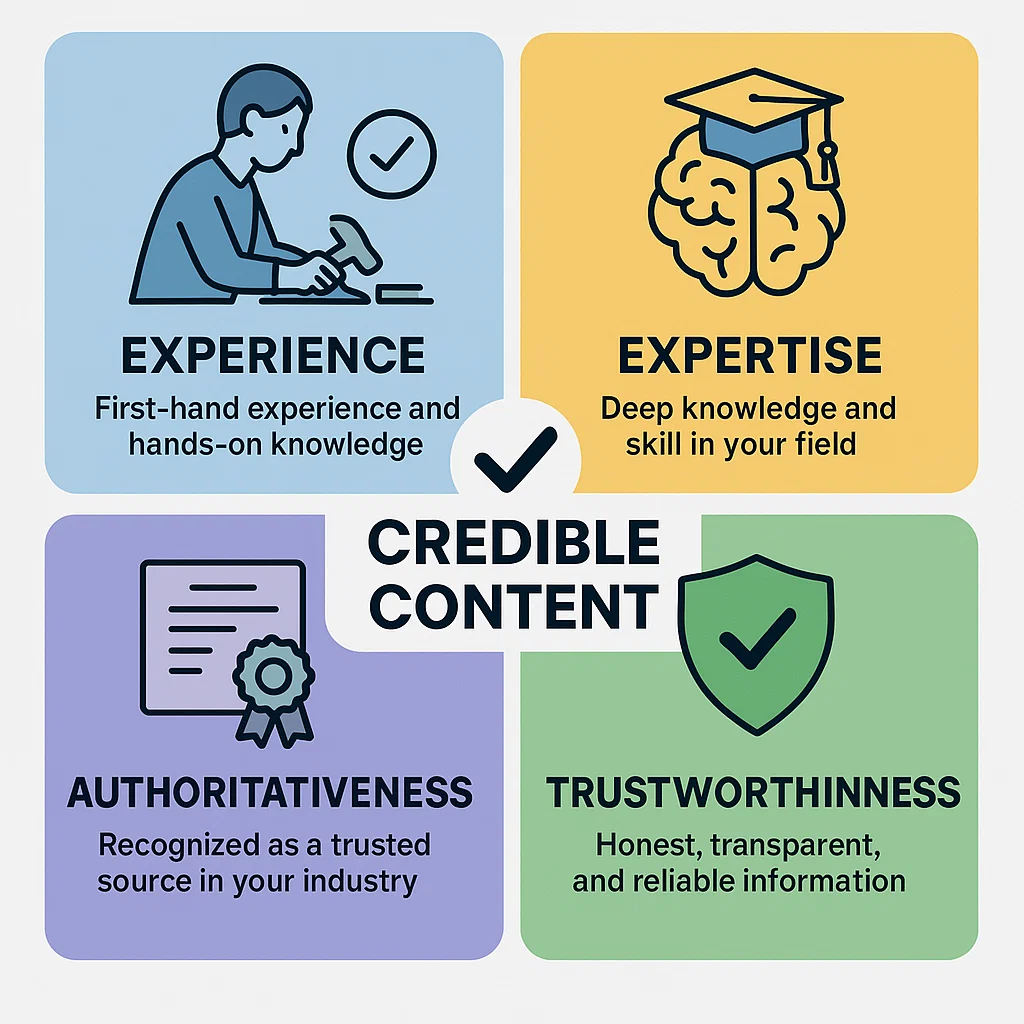
In 2026, the kind of content you create is crucial more than ever. Google has shifted its focus to rewarding content that shows clear competence and authority as well as credibility. This framework is known as E-E-A-T.
E-E-A-T: Experience, Expertise, Authoritativeness, Trustworthiness
E-E A-T is becoming more important for ranking, particularly in niches with high competition. Let’s take a look at the meaning of each component:
Expertise means that you are knowledgeable about the subject matter thoroughly. You should show understanding, knowledge and proficiency in your field. This is evident in the manner you write and the quantity of information you offer.
Authoritativeness means that you’re acknowledged as a reliable expert in your field. This includes credentials as an author and professional background, as well as qualifications, and education. It also includes the citations of other experts as well as recognition in your industry.
The term “trustworthiness” means that your website is secure and transparent. It also means that it is honest. It means the use of clear privacy policies, clear contact information and valid credentials. It’s about delivering on promises and being truthful in all you publish.
Experience is the latest update to E-E A-T. It means that you have direct experience of what you’re talking about. If you’re writing about marketing have you actually conducted marketing campaigns? If you’re writing on fitness Have you personally trained anyone?
Experience from the inside makes your content stand out from content generated by AI. Your writing becomes more valuable and trustworthy.
Original Content vs. AI-Generated Content
The fight between human-authored content and artificially-generated content is a key ranking factor right now. Google favors content written by human beings with expertise and not created by AI to attempt to rank for keywords.
What is it that makes content unique and valuable?
- Personal experience and perspectives
- Opinionated commentary based on knowledge
- Deep insights, data-driven analysis and insight
- Real-world examples and case studies
- Multimedia storytelling
- Unique insights that no one else has published
- Depth and completeness
Content that AI isn’t able to easily replicate has a distinct advantage in ranking.
Content Freshness Strategy
As we have discussed the importance of content freshness, it is now an important factor in 6 percent of your rank power. This means that you must have an approach to keep your content up-to-date.
The best way to approach this is:
- Check your best-performing pages each 3-4 months
- Up-to-date statistics and data, including the most current information
- Add new sections about recent developments
- Enhance sections that are not up to date
- Refresh pictures and screenshots
- Enhance the depth and quality of your work.
When you change a page, make sure you change the date of publication or include the “Last Updated” date. This tells Google that your content is new.
Topical Authority and Content Clusters
The process of building authority in a topic involves becoming a respected expert in your field. You can achieve this by constructing complete content clusters centered around specific subjects.
A content cluster is comprised of:
- A pillar page which covers the main subject of your article
- Multiple pages of clusters that go into subtopics that are specific to the topic.
- Internal links that link all pages in the cluster back to the page of the pillar
For instance, if your primary subject is “SEO,” your pillar page could include “The Complete SEO Guide,” and your cluster pages could cover “Keyword Research,” “Link Building,” “Technical SEO,” and so on.
This structure informs Google that you’re an expert on your primary subject.
Off-Page Ranking Factors and Backlink Strategy for 2026
Off-page ranking factors are outside your website, but they can influence the way Google evaluates your website’s pages. One of the most significant off-page ranking factors is your backlink profile.
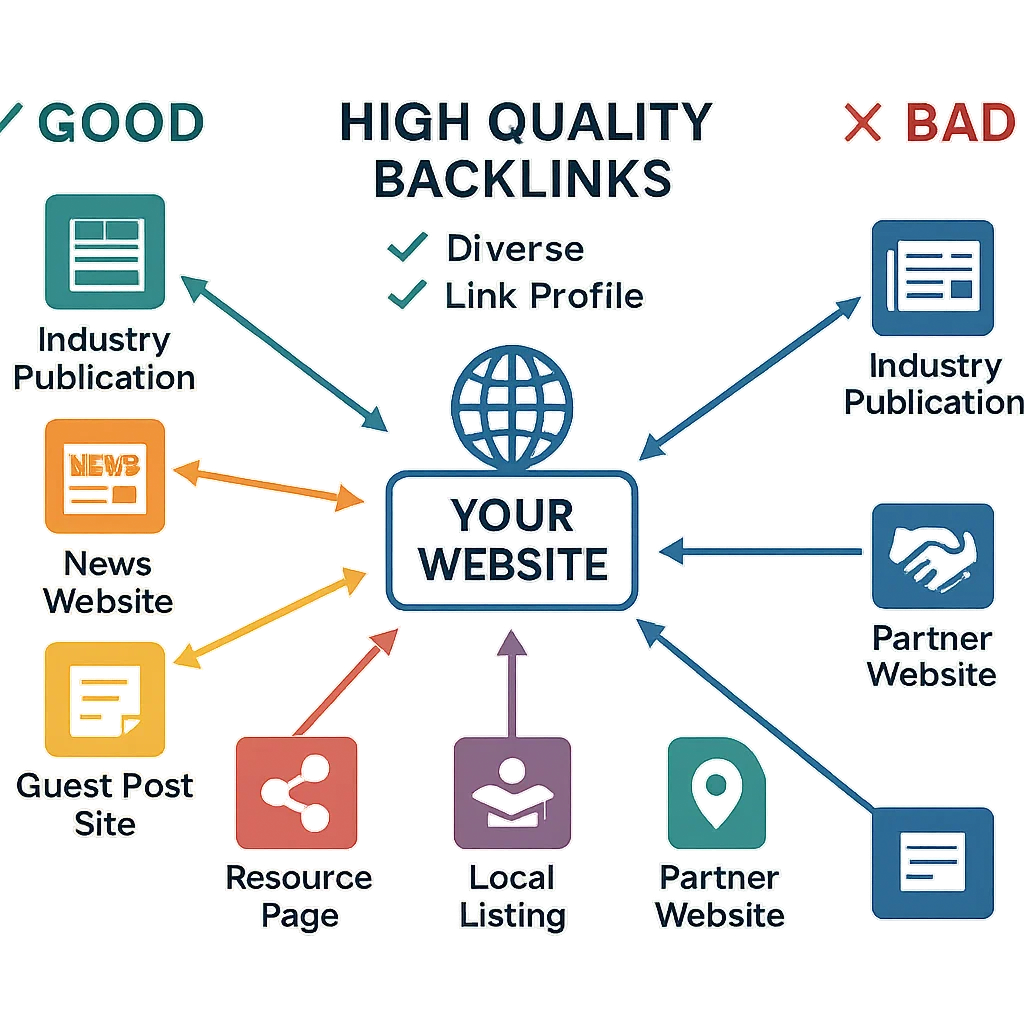
Quality Backlinks: The Foundation of Authority
A backlink is hyperlink from a different site to yours. Good backlinks are like affirmations of trust, telling Google that your website’s content is important and worthy of being ranked higher.
However, quality is more important than quantity. A backlink from an relevant, authoritative website is worth much over 100 backlinks on spammy websites.
What is it that makes a high-quality backlink? quality?
- The website’s content can be relevant to the industry you work in.
- The source website has a high authority on domains.
- The website’s source is regarded as reliable by Google
- The link is naturally within the content
- The anchor text is descriptive.
Link Distribution Diversity: A New Focus for 2026
Link distribution diversification is now considered an important factor in ranking, accounted for the equivalent of 3% of your power ranking. This means that having backlinks from diverse types of sources is more effective than obtaining all your links from one particular type of website.
For instance having 20 backlinks coming from different publications in the industry is superior to having 50 backlinks from a single publication. Diversity is important.
Your backlinks should originate from:
- Industries publications and blogs
- Directories with high-authority
- News websites
- Educational institutions
- Opportunities to guest post
- Pages on resources
- Local business listings
Building a Natural Backlink Profile
The best backlinks naturally come from creating content that people will want to hyperlink to. But, you can also actively build backlinks by:
Guest post writing posts for other sites in your field and incorporating a link to your website.
Broken link building Searching for broken links on websites that are relevant and offering your content as an alternative.
Resources page link – identifying “resources” pages on relevant websites and suggesting your content as a useful addition.
Outreach and building relationships Connecting with influencers and leaders who may be able to link your website’s content.
Avoiding Toxic Backlinks
Not all backlinks can help your rankings. Infected backlinks from spammy or irrelevant sites can harm your rankings. Check your backlink profile regularly and eliminate toxic links in Google Search Console.
Searcher Engagement and User Experience Signals
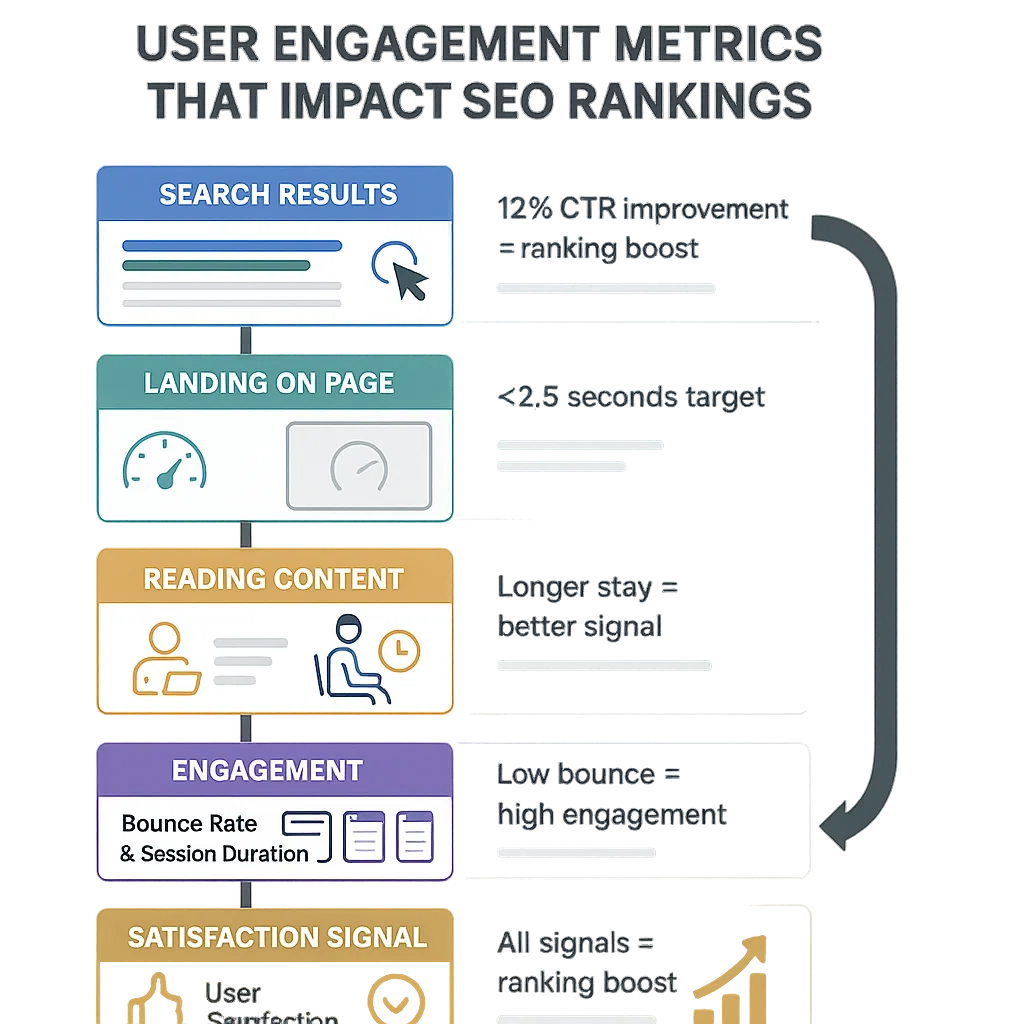
Engagement signals from search engines determine how satisfied people are about your site’s contents. These signals make up 12 percent of your search ranking capacity in 2026.
Click-Through Rate (CTR) Optimization
The click-through rate is the percentage of users who click your website’s result after seeing it in Google results. A greater CTR indicates to Google that your site’s content is useful and attractive.
To improve CTR:
- Make compelling title tags for your website that contain your key word
- Create engaging meta descriptions
- Include numbers and powerful phrases in your titles
- Test various variations
- Your work should stand apart from the competition
A mere 1% increase in CTR could have a significant impact on your ranking.
Dwell Time: How Long People Stay on Your Page
Dwell time is the amount of time the user stays on your site before they return to Google results for search. A longer dwell time indicates that your content was useful and interesting.
To increase dwell time:
- Write high-quality, engaging content
- Use clear headings and subheadings.
- Break content into brief paragraphs
- Include images and videos.
- Make bold text your primary tool to highlight important aspects
- Use internal links for similar content
- Load your page quickly
Bounce Rate and Session Duration
Bounce rate indicates the percentage of users leave your site, without seeing additional pages. A high bounce rate could indicate that your that your content doesn’t meet expectations of the users.
The duration of sessions shows the amount of time people visit your website in general. Sessions that are longer indicate greater engagement.
To increase these measures:
- Be sure that your content is in line with the search intent
- Increase the speed of your website
- Make your site more attractive and improve navigation
- Make your content simple to scan
- Include a clear call-to action
Mobile User Experience Signals
With the introduction of mobile-first indexing on your site the mobile user experience is getting more and more vital. Be sure that your website:
- Quickly loads on mobile
- It’s easy to navigate via the use of a touchscreen
- Text that is readable without zooming
- Have buttons that are appropriately sized.
- Doesn’t display annoying pop-ups
Brand Authority and Trust Factors
In 2026, the authority of brands plays a greater part in rankings. Google is looking to rank established brands with the trust and credibility of their respective markets.
Brand Signals and Brand Searches
Brand signals are:
- Brand searches (people looking for your business by name)
- Brand and keyword searches (people looking for your brand with your industry’s keywords)
- Brand names are mentioned across the internet
- Official brand profiles for brands
The more people who search for your name, the greater authority Google gives your website.
Building Brand Authority
To establish brand authority:
- Create consistent high-quality, high-quality content
- Create your own thought leadership in your field
- Get featured in publications for the industry.
- Create communities through social media
- Find positive testimonials and reviews
- Create a brand identity that is recognized
- Participate in industry-related discussions
Citations and Local Business Signals
Citations are the mentions of your company’s name address, address, and telephone number on the internet. A consistent way of presenting these details is essential to local SEO.
Include your information in directories that are relevant:
- Google Business Profile
- Directories specialized to industry
- Local directories of business
- Chamber of Commerce listings
Algorithm Updates and How Rankings Have Changed in 2026
Google’s algorithm is constantly changing. Understanding how these changes have altered weights of ranking factors helps you to adapt your strategy.
Major Changes Since 2025
The most significant change in 2026 is the dramatic rise in importance of freshness of content. What was once less than one percent of rankings has increased to 6 percent. This shows Google’s understanding that keeping content updated is becoming increasingly crucial.
The number of signals that indicate engagement from users has increased from 10 percent to the 12% mark. Google is focusing more on whether users are happy with the results they get.
Link distribution diversity is officially acknowledged at 3percent. This suggests that Google has rewarded websites that have diverse backlink profiles.
The Helpful Content Update Impact
Google’s Helpful Content Update continues to encourage content that actually aids users over content created solely to be ranked for keywords. The update gives:
- Experience first-hand
- Opinionated commentary
- Data-rich insights
- Expert analysis
AI Overviews and New Search Features
AI Overviews have transformed the way people interact with results from a search. Instead of clicking on websites, a lot of search results now include AI-generated summaries in the results of searches.
To be featured on AI Overviews, you need:
- Well-structured, clear content
- Direct answers to the most common questions
- A comprehensive coverage of subjects
- Proper schema markup
Common Myths About Ranking Factors vs. Reality
There’s plenty of misinformation regarding SEO rankings factors. Let’s debunk some common misconceptions.
Myth: Keyword Density Determines Rankings
Realism: Keyword density is mostly irrelevant. Google makes use of semantic understanding to judge the relevance not the density of keywords. Concentrate on natural keywords and topic-specificity rather than hitting a particular percentage of keywords.
Myth: Exact Match Domains Have an Advantage
Reality: Having an exact match domain (like seo-ranking-factors.com for the keyword “SEO ranking factors”) provides minimal ranking advantage. Content quality is more important than the domain name.
Myth: Social Signals Directly Impact Rankings
Realities: While social shares do not directly affect rankings but they can generate traffic and links that can affect rankings. Create a social presence as a part of a larger strategy but don’t count on it to improve rankings directly.
Myth: You Must Publish Content Frequently
Real-world: Publishing frequency matters less than the quality of content and its freshness. A well-written and updated article is better than weekly average articles. Concentrate on quality over frequency.
Myth: Domain Age Strongly Influences Rankings
Real-world: While older domains may have more authority due to decades of link building experience, modern domains can rank similarly with high-quality information and link building.
Myth: Meta Keywords Still Matter
Real: Google stopped using meta keywords to rank their websites a few some time ago. You can disregard this HTML element to improve SEO.
SEO Ranking Factors Checklist for 2026
Here’s a comprehensive checklist to ensure you’re optimizing for all the important ranking factors:
Content Quality Checklist
- ✓ Original, high-quality content (not AI-generated)
- ✓ First-hand experience evident in writing
- ✓ Opinionated commentary and unique perspective
- ✓ Data-rich insights and case studies
- ✓ Comprehensive coverage of the topic
- ✓ Clear E-E-A-T signals
- ✓ Updated content with fresh information
- ✓ Minimum annual updates to top pages
Technical SEO Checklist
- ✓ LCP under 2.5 seconds
- ✓ CLS below 0.1
- ✓ INP under 200 milliseconds
- ✓ Mobile responsive design
- ✓ HTTPS and SSL certificate
- ✓ XML sitemap submitted
- ✓ Robots.txt optimized
- ✓ No crawl errors in Search Console
On-Page Optimization Checklist
- ✓ Primary keyword in H1
- ✓ Primary keyword in first 100 words
- ✓ Meta title under 60 characters
- ✓ Meta description under 160 characters
- ✓ Proper H2 and H3 structure
- ✓ Long-tail keywords naturally included
- ✓ LSI keywords throughout
- ✓ Image alt text with keywords
- ✓ Internal links to related content
Backlink and Authority Checklist
- ✓ Quality backlinks from relevant sources
- ✓ Diverse backlink sources
- ✓ No toxic or spammy backlinks
- ✓ Natural anchor text
- ✓ Brand mentions across the web
- ✓ Local business listings complete
- ✓ Citations with consistent NAP
- ✓ Guest posting opportunities pursued
User Experience Checklist
- ✓ High click-through rate optimization
- ✓ Low bounce rate
- ✓ Long dwell time on pages
- ✓ Mobile user experience optimized
- ✓ Clear navigation structure
- ✓ Fast loading pages
- ✓ No intrusive pop-ups
- ✓ Accessible content design
Tools for Monitoring and Improving Your Rankings
Tracking your ranking factors helps you understand what’s working and what needs improvement.
Google Search Console
Google Search Console is the most important tool for understanding how Google sees your website. Monitor:
- Search queries bringing traffic
- Click-through rates
- Average ranking positions
- Mobile usability issues
- Indexation status
- Core Web Vitals data
Google Analytics 4
Google Analytics shows how users interact with your site. Track:
- Traffic sources
- User engagement metrics
- Bounce rate and session duration
- Pages per session
- Conversion rates
- User behavior flow
Rank Tracking Tools
Monitor your rankings for target keywords:
- Google Search Console (free, but basic)
- Ahrefs
- SEMrush
- Ubersuggest
- Moz
Site Audit and Technical Tools
Identify technical SEO issues:
- Google PageSpeed Insights
- Screaming Frog
- SE Ranking
- Surfer SEO
Backlink Analysis Tools
Analyze your backlink profile:
- Ahrefs
- SEMrush
- Moz
- Majestic
Future-Proofing Your SEO for 2026 and Beyond
The SEO landscape is continuing to change. Here’s how you can keep ahead of the trend.
Preparing for AI-Driven Search
AI is changing how people use search engines and the way Google shows results. To be ready:
- Make content AI systems might want to use
- Use a clear structure and appropriate schema markup
- Answer in depth to all common questions
- Concentrate on unique insights and the latest data
- Create authority in the field.
Multi-Platform Discovery Strategy
Do not rely solely on Google. Establish your brand on:
- TikTok (especially to reach younger audience members)
- Reddit (growing as alternative search engine)
- YouTube (video videos are becoming increasingly useful)
- LinkedIn (B2B and professional content)
- Twitter/X (real-time conversations)
Building Owned Communities
Reduce dependence on traffic from search engines through developing community owned communities:
- Email lists
- Newsletters
- Forums for community members
- Private membership websites
- Social media networks
Creating AI-Resistant Content
Content that AI cannot easily duplicate gives you a competitive edge:
- Direct experience
- Case research
- A detailed analysis of data
- Original research
- Opinionated or controversial takes
- Video demonstrations and visual demonstrations
30-Day Action Plan to Optimize All Ranking Factors
Are you ready to improve your ranking? Here’s a plan for action that lasts for a month.
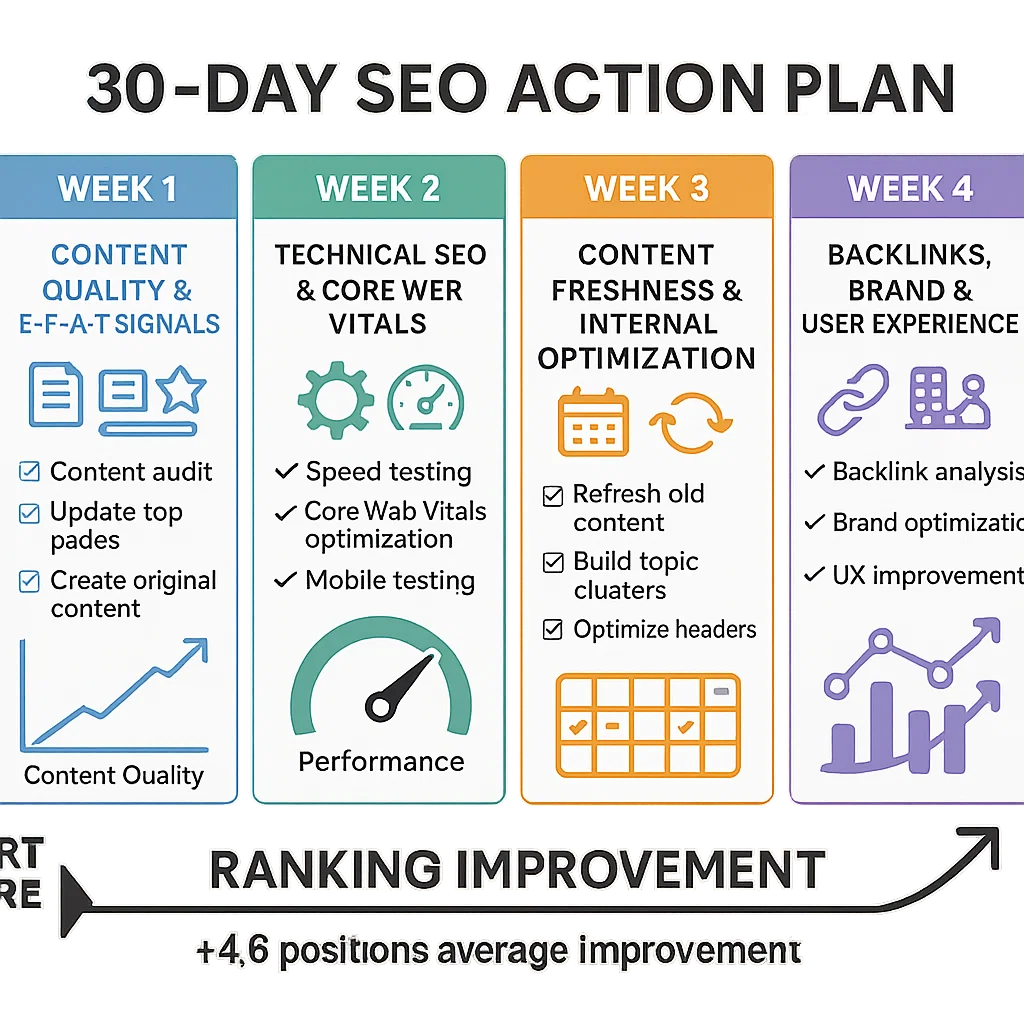
Week 1: Content Quality and E-E-A-T Signals
Days 1 and 2: Audit your existing content. Look for sites that may be improved by new information, examples, or even more expert signals.
Days 3-4: Update your top-performing pages. Update your information, add new content, statistics, and enhance E-E-A-T signals by the author’s credentials.
Days 7 – Create a new piece of content that showcases personal experiences or unique perspectives. Create a comprehensive and detailed piece of content.
Week 2: Technical SEO and Core Web Vitals
Days 8-9: Test your website speed by using Google PageSpeed Insights. Determine the biggest issues and make a list of suggestions for improvement.
Days 10-12: Implement speed improvements. Compress images or enable caching, minimize code or update hosting as required.
Days 13-14: Test mobile responsiveness across different devices. Check that your site is working flawlessly on all sizes of screens.
Week 3: Content Freshness and Internal Optimization
Days 15-17: Review your top 10 most successful pages. Update your data, add different examples, and increase the depth of content.
Days 18-19: Build topic clusters by creating pages that are pillar pages as well as cluster pages which have internal links.
21st of April: Optimize all your header tags (H1 H2, H2, and the H3) to include long-tail and primary keywords naturally.
Week 4: Backlinks, Brand Building, and User Experience
Days 22-24: Conduct backlink analysis. Find potential guest posts or broken link building and linking to resource pages.
Days 25-26: Research and optimize your Google Business Profile (if you have an local business). Make sure that all information is correct and accurate.
Days 27-28: Review your brand presence. Check that author bios are accurate and visible. Also, ensure that your credentials are clear and that trust signals are clearly displayed.
Days 29-30: Analyze your user engagement metrics. Determine pages that have large bounce rates, and design improvements.
Conclusion: Mastering SEO Ranking Factors for Long-Term Success
Knowing the SEO ranking factors is the initial step to increasing your search engine visibility. However, knowledge alone isn’t enough. You must act and implement these methods on your site.
Focusing on the most crucial ranking factors, such as content quality and searcher engagement as well as topical authority backlinks, as well as the freshness of your content will allow you to stand ahead of your competitors. These factors make up most of the power you have in ranking.
Keep in mind that SEO isn’t an event; it’s an entire marathon. Results require time. You may not see significant improvements for the next 3-6 months. However, if you continue to implement these strategies for ranking factor optimization you will see improvements in the visibility of your search results.
Concentrate on delivering genuine value for your viewers. Create original content using the experience of a professional. Keep your content up-to-date and fresh. Build high-quality backlinks from reliable sources. Improve your SEO on technical aspects. Always put user experience first.
If you follow these steps and you do these things, higher rankings for your website naturally follow. You’ll be able to attract higher organic traffic, establish your authority as a brand and build a long-term sustainable growth through SEO.
Begin with today’s. Select one of the areas from the list and start optimization. As you work to improve each ranking aspect, you’ll see your website rank higher in Google results for search results.
Frequently Asked Questions About SEO Ranking Factors
Q: How long does it take to see ranking improvements?
A: Most websites see noticeable improvements within 3-6 months of consistent optimization. Competitive keywords may take longer. Be patient and consistent.
Q: Can I rank without building backlinks?
A: Backlinks are still very important (13% of ranking factors), but exceptional content with high engagement signals can sometimes rank well without many backlinks. However, most competitive keywords require a strong backlink profile.
Q: Which ranking factors should I focus on first?
A: Start with content quality and freshness (33% combined), then tackle technical SEO and Core Web Vitals. Finally, build backlinks and brand authority. This order addresses the most impactful factors first.
Q: How often should I update my content?
A: At minimum, review and update your top-performing pages annually. For highly competitive topics, update every 6 months. The more you update, the more freshness boost you get from that 6% ranking factor.
Q: What’s more important: internal links or external backlinks?
A: External backlinks are more important for establishing authority. However, internal links are crucial for distributing authority and establishing topical relevance within your site. Use both strategically.
Q: Do I need a high domain authority to rank?
A: No, new domains can rank well with excellent content and targeted link building. Building domain authority takes time, but you don’t need high authority to start ranking for less competitive keywords.