Introduction: What is SEO and Why Does Ranking Matter for Your Website?
Search Engine Optimization also known as SEO is among the most effective digital marketing strategies that can increase SEO exposure for your site. If you’re seeking ways to improve the SEO of your website and implement better SEO strategies you’ve come to the right spot. In today’s online world that is highly competitive knowing how to increase SEO rankings naturally is crucial for any company looking to be successful online.
SEO ranking improvement isn’t just about gaining more traffic. It’s about attracting the right kind of traffic. When you know how to improve your SEO rankings quickly and effectively you’re investing in the long-term success of your business. In contrast to paid advertisements organic traffic growth through the correct SEO optimization techniques is a cost-effective method to draw in potential clients who are looking for your product or services.
The importance of enhancing SEO cannot be overemphasized. Rankings on search engine result pages (SERPs) result in increased exposure, more clicks and, ultimately more conversions. If you’re running a small company or a huge enterprise knowing how to improve your SEO rankings for small businesses or at the enterprise level SEO methods will help you succeed in your field.
What Are SEO Ranking Signals and How Do They Work?
Before we go into the technicalities, let’s consider what Google will be looking at when deciding which websites should be ranked higher. Google’s algorithm utilizes over 200 ranking elements to determine the order in which search results appear. These include elements on the page as well as technical SEO enhancements, backlink quality, as well as indicators of user experience.
When you implement the correct SEO rankings signals optimization, you’re basically saying to Google: “This website is relevant, authoritative, and trustworthy.” More signals you can optimize, the higher chances you have of getting higher rankings and boosting the amount of organic traffic to your website.
How to Optimize On-Page Elements to Increase SEO
Title Tags and Meta Descriptions Optimization
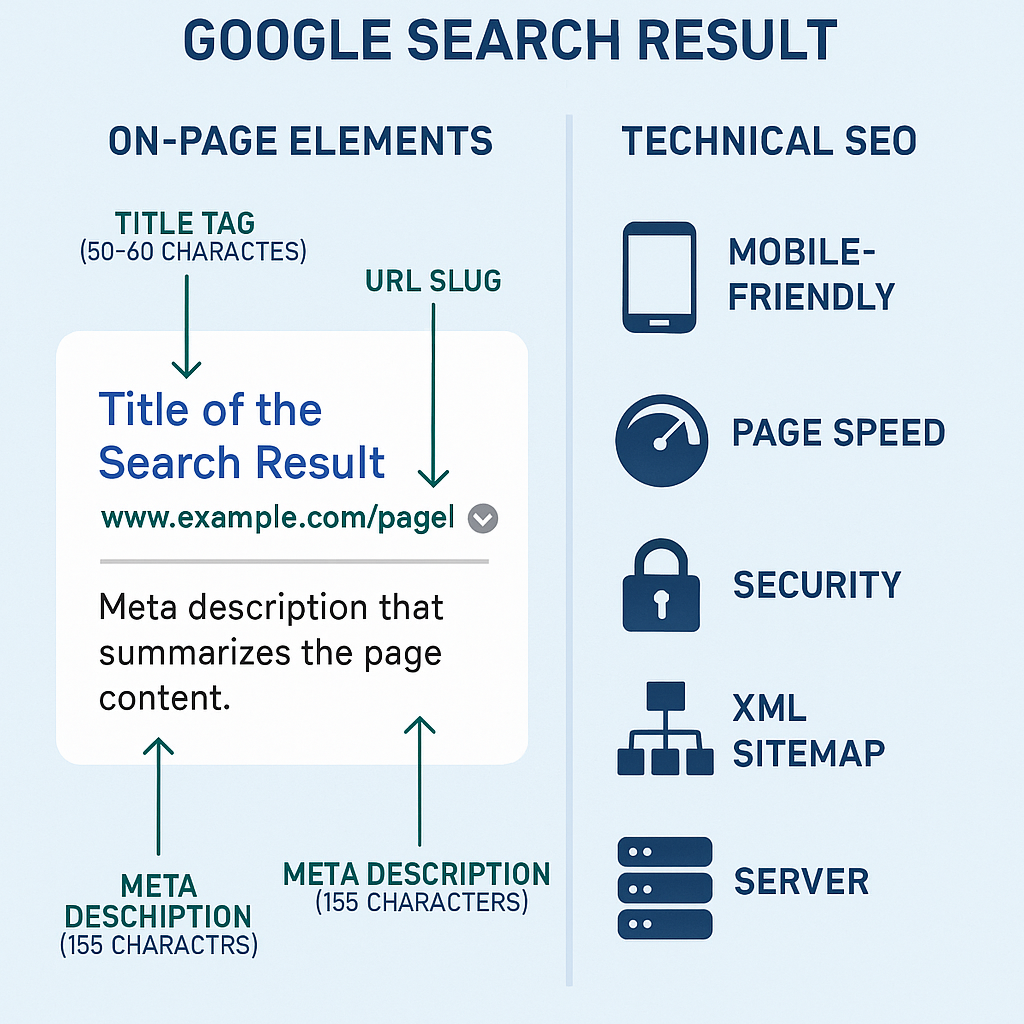
The title tag of your website is the first impression your site gives potential visitors. It’s the headline you see in results of searches, and it’s essential for boosting organic traffic. A well-optimized title tag must contain the primary keywords naturally, while accurately describing the content.
The meta description of your website is the short summary that appears under your title tag on the results of your search. While it does not directly affect rankings, it can significantly impact the click-through rate (CTR growth). A compelling meta description could boost your CTR by as much as 30 percent which is an important ranking factor.
Title tags that are best practice:
- Keep it to 50-60 characters.
- Include your primary keyword near the beginning of your article.
- Make it engaging and click-worthy.
- Avoid keyword stuffing
Best practices for meta descriptions:
- Keep it between 150 and 160 characters.
- Use your main keyword naturally
- Include an appeal to action
- Make it distinct for every page
Keyword Placement in Content Strategy
The placement of keywords in content is a science and art. It is important to carefully include your keywords in your content, without hindering readability. The goal is a natural keyword integration that benefits both users and search engines.
Begin by putting your main keyword, in this case, “how to increase SEO”–in the first 100 words of your content. This will tell Google instantly what your article is about. Through your content, naturally include your long-tail keywords, such as “how to increase SEO ranking naturally,” “how to improve SEO without paying,” and “how to increase SEO in 30 days.”
Do not use keyword stuffing at any cost. Search engines are now sophisticated enough to know the instances where you’re not naturally repeating keywords, and this can harm your rankings, instead of helping them. Instead focus on semantic SEO and latent semantic Indexing (LSI) with the help of similar terms and variations naturally in your text.
Header Tags Optimization (H1, H2, H3)
The structure of your header tag is essential for search engine optimization and the user experience. The H1 tag must contain your principal keyword and only be displayed only once per page. Consider your H1 tag as the title of a book. It should accurately reflect the entirety of the content.
H2 tags are subheaders which break your text into bite-sized chunks. They should include long-tail keyword phrases and related variations. H3 tags help arrange content in H2 sections. This hierarchical structure assists Google recognize the structure of your content and improves the readability of your content.
Image Alt Text and Optimization
Images are a powerful tool for generating engagement from users however, search engines cannot “see” images the way humans do. This is the reason alt text is important. The alt text you choose should be descriptive and describe what the image depicts and, if appropriate it is essential to include keywords.
Also, optimize your images using:
- Squeezing them to increase speed of pages
- Using descriptive file names
- Giving context to the image
- Using responsive images for mobile devices
Internal Linking Strategy
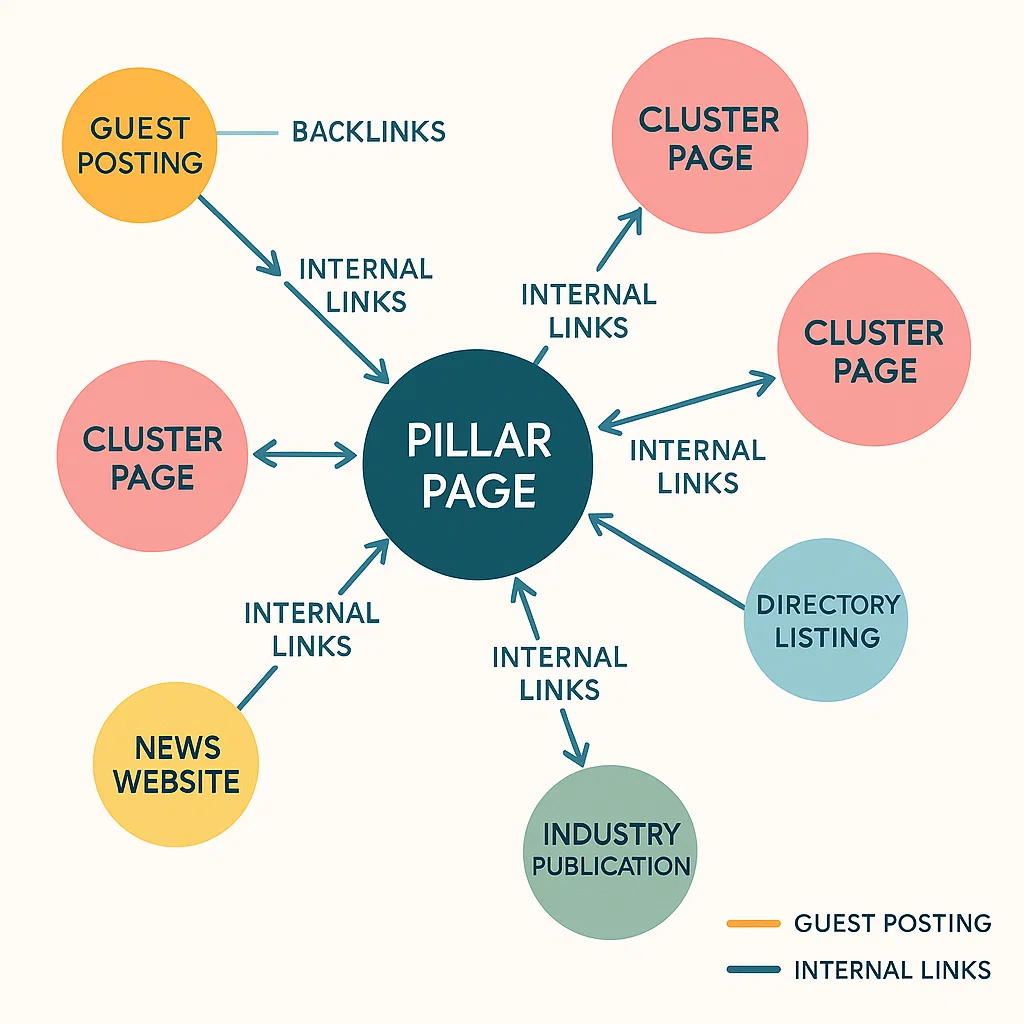
Internal linking is among the most neglected SEO best techniques. When you link between pages page on your website you spread authority and assist Google comprehend the structure of your site. If you hyperlink from a highly-authority page to a brand new page that has anchor text such as “how to increase SEO ranking,” you’re passing on authority and relevancy signals.
Internal linking can also keep users on your site for longer increasing bounce rate and enhancing the efficiency of your dwell time. This is a win-win situation for both SEO and the user experience.
Content Length and Depth
Research has consistently shown that more extensive, longer content is more popular than a thin content. For keywords that are competitive, such as “how to increase SEO,” try to write at least 3,000 to 4,000 words. This allows you to write about the subject and incorporate many keywords naturally.
But, the length of content is important only in the case of content that is top-quality. A thorough analysis of thin vs. comprehensive content indicates that search engines favor depth and understanding over just word count. Make sure that every paragraph provides value to the readers.
Technical SEO Improvements: Foundation for Better Rankings
Website Speed Optimization
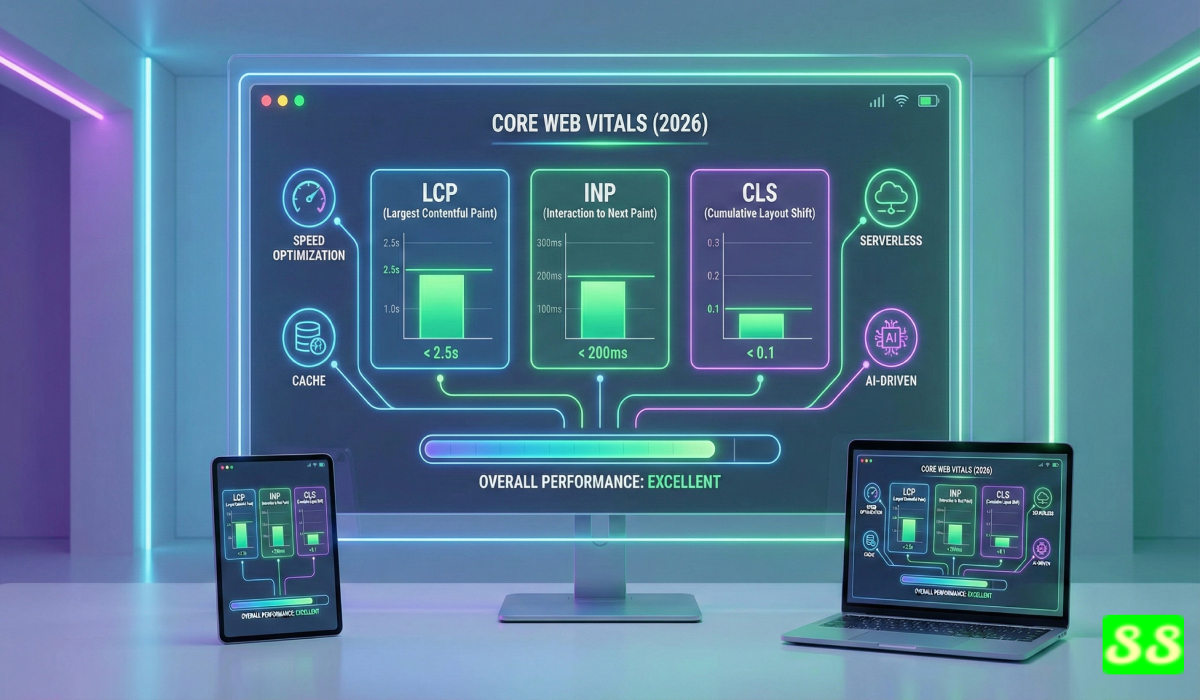
Speed of page loading is a proven ranking factor in both mobile and desktop search results. Google utilizes Core Web Vitals to measure the speed of loading as well as visual stability and interactivity. Slow websites are less popular and also have higher bounce rates.
To improve your website speed:
- Enable caching for your browser
- Compress images without sacrificing quality
- Minify CSS and JavaScript
- Use a Content Delivery Network (CDN)
- Select a good hosting provider
- Eliminate unnecessary plugins
Mobile-Friendly Design (Mobile-First Indexing)
With more than 60% of search results being conducted on mobile devices mobile optimization is no more a luxury, it’s vital. Google makes use of mobile-first indexing which means it crawls and indexes your mobile-friendly version of your website.
Check that your website’s URL is:
- Highly responsive across all devices
- Mobile connections are fast and reliable
- Text is readable and not zoomed out
- Includes clickable buttons as well as links that are properly in size
- Free of intrusive interstitials
SSL Certificate and HTTPS
A SSL certificate (indicated by the HTTPS mark in your URL) protects the data exchanged between your website and its visitors. Google has confirmed that HTTPS is an important ranking factor. It also helps build trust with your customers which reduces bounce rates and increasing user engagement metrics.
Installation of an SSL certificate is a common practice and is usually provided for free by your hosting provider.
XML Sitemap Creation
A XML sitemap is a document that lists all the most important pages on your site. It assists Google find and crawl your entire website efficiently. A properly formatted XML sitemap should contain:
- All important URLs
- Last modified date
- Update frequency
- Priority level
Send your XML sitemap to Google Search Console to ensure Google is aware of the pages you have.
Robots.txt Optimization
Your robots.txt file informs crawlers on search engines what pages they are able to access and are not able to access. A properly optimized robots.txt file:
- Lets Google to crawl key pages.
- Blocks with low-value content (like thank-you pages)
- Prevents budget waste that is crawling
- Points to your XML sitemap
Structured Data and Schema Markup
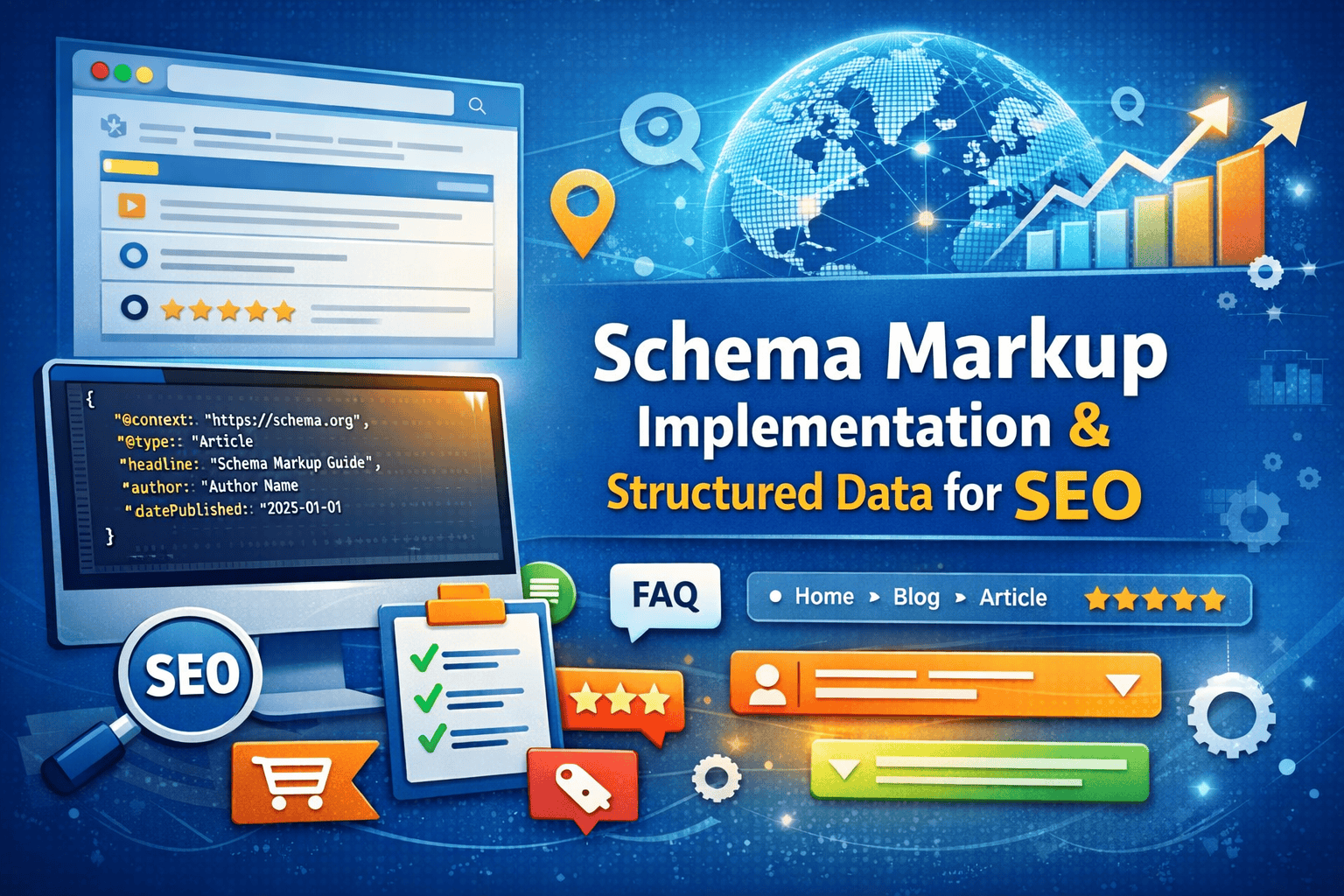
Schema markup assists search engines better understand your content. It gives context to your products, content articles, products, and more. Schema markup implementation can result in rich snippets of content within search results, thereby increasing your click-through rates.
Common schema types for blogs are:
- Article schema
- BreadcrumbList schema
- FAQPage schema
- Organization schema
Core Web Vitals Optimization
Google’s Core Web Vitals measure three aspects of the user experience:
Largest Contentful Paint (LCP): How fast the main content is loaded. The goal is less than 2.5 seconds
Cumulative Layout Shift (CLS): How much content changes as the webpage loads. Target: Below 0.1
First Input Delay (FID): How responsive your website is to user interaction. The goal is to be below 100 milliseconds.
Creating SEO-Optimized Content That Ranks Higher
Keyword Research Methodology
A successful SEO strategy starts by conducting a thorough keyword analysis. You must know what your target audience is looking for and the difficulty it is to rank for these keywords.
Utilize tools such as Google Keyword Planner, Ahrefs, SEMrush, or Ubersuggest to:
- Find the search volume for your keywords of choice
- Analyze the difficulty of a keyword
- Know the intent of the user
- Find similar keywords and variations
- Examine competitor keywords
When you are researching keywords related to topics like “how to increase SEO ranking naturally” or “free ways to increase SEO,” be sure to consider both the volume of searches and the intent. A keyword that has 1,000 monthly searches could be more easy to rank than one that has 10,000 searches.
Content Cluster Strategy
Instead of creating individual blog posts, adopt the concept of a content cluster. This means creating a foundation page that covers a broad subject (like “how to increase SEO”) and a number of cluster pages that delve into specific topics.
Link all pages in the cluster back to the main page using the same anchor words. This creates an authority signal that informs Google that you are an expert in the area.
Semantic SEO and Latent Semantic Indexing (LSI)
Semantic SEO is the process of understanding the user’s intent and context not just the keywords. Google now employs natural language processing in order to recognize the synonyms and terms that are related to it.
Instead of merely using “how to increase SEO,” naturally include:
- SEO ranking rises
- Improve the SEO of your website
- Better SEO techniques
- How can I increase SEO traffic quickly
- SEO optimization strategies
- Improved visibility on websites
- Organic traffic increase
This will make your content more complete and helps Google to recognize that you’ve covered the subject in depth.
Content Freshness and Updates
The freshness of your content can be a major ranking factor. Continuously updating your content indicates to Google that it’s up-to-date and relevant. Set a reminder on your calendar to check and update your most popular content every three months:
- New statistics and data
- Updated best practices
- Current tool recommendations
- New examples
Content Gap Analysis
Find out what your competition is writing about that you aren’t. Discover the content gaps and fill them in with your own unique perspective. This allows you to create more complete content and identify keywords that are lacking.
How to Build Quality Backlinks and Domain Authority
Understanding Backlinks and Domain Authority
A backlink is hyperlink from a different website to yours. Backlinks that are of high quality act as signals of trust, telling Google that your site is reliable and trustworthy. Authority of your domain and pages are determined by the quantity and quality of backlinks that you have.
When creating backlinks, you should focus on quality over the quantity. A backlink from a reputable website is more valuable than 100 backlinks from low-quality websites.
Guest Posting Strategy
Guest posting is among the most effective ways to build backlinks. Write an article on a different website that is in your field and then include a link back to your website. This adds an audience with value and also increasing your credibility.
If you are looking for guest-posting opportunities:
- Websites that are targeted that have a high authority on domains
- Select websites that are that are relevant to your field
- Create original, high-quality content that is unique and original.
- Include natural hyperlinks in your author bios or in your content
- Expect a 3-6 month delay before you see the ranking benefits
Broken Link Building
Look for links that are broken on top-quality websites that specialize in your field and provide your website as a substitute. Tools such as Check My Links or Broken Link Checker can assist you in identifying these opportunities.
The procedure involves:
- Find broken links on official sites
- Finding pertinent content on your website that can replace your broken link
- Contacting the owner of the website
- The suggestion of your content as a substitute for
Resource Page Link Building
Many websites have “resource” or “tools” pages that provide links to helpful websites in their field. Find these sites and offer your content to them as an excellent supplement.
Brand Mentions and Citations
Some backlinks are not derived directly from link-building initiatives. When people talk about your brand name or write about your business these citations increase credibility, even without links.
Monitor mentions of your brand using tools such as Google Alerts and contact websites that have mentioned you to request for a link.
High-Authority Backlink Sources
Concentrate on building backlinks to
- Industry publications
- Educational institutions (.edu sites)
- Government websites (.gov websites)
- Directories of high-authority industries
- Interviews and podcasts with relevance
- Press releases
Avoiding Toxic Backlinks
All backlinks are not beneficial. Backlinks that are toxic from irrelevant or spammy sites could actually harm your rankings. Make sure you regularly check your backlink profile and use tools to disavow your links within Google Search Console to tell Google to block harmful links.
Increasing Local SEO Rankings for Your Business
If your business operates in an area that is geographically specific local SEO is vital. Local SEO optimization will help you show up in local results on maps and search results.
Google My Business Optimization
Your Google My Business profile is the basis of SEO local. Make sure that it’s:
- Complete with all business details
- Updated with the current hours and number of the phone.
- High-quality images
- Does the business have a full description
- Regularly updated with new posts
Local Citations and NAP Consistency
Citations are the use of your business’s name Address, address, and phone number on the internet. Be consistent in the way you display this information is crucial. Your business should be listed on:
- Google My Business
- Local directories (Yelp, Yellow Pages)
- Directories specialized to industry
- Chamber of Commerce local to the area
Local Backlinks
Create backlinks using local sources:
- Local news websites
- Community-based organizations
- Local business associations
- Local event sponsorships
Location-Specific Keywords
Include location-related keywords naturally into your content:
- “How to increase SEO in [Your City]”
- “SEO services for [Your Industry] in [Your Location]”
- “Best SEO strategies for [Your Area]”
How User Experience Impacts SEO Rankings
Click-Through Rate (CTR) Improvement
The click-through rate of your website is the proportion of users who click on your URL in the results of a search. A high CTR indicates Google Google that your site’s content is relevant and attractive to searchers.
To improve CTR:
- Create captivating title tags for your articles.
- Create engaging meta descriptions
- Make use of numbers and words that are powerful.
- Include your targeted keyword
- Test various types of (A/B testing)
Bounce Rate Reduction
The bounce rate represents the proportion of users who leave your website without taking any action. A high bounce rate indicates poor quality content or lack of relevance. Reducing bounce rates by:
- User expectations are met in results of searches
- Speeding up page load speeds
- Making sure mobiles are responsive
- Utilizing clear navigation
- Providing engaging content
Dwell Time Optimization
Dwell time is the length of time an individual spends on your site before returning to results from a search. Longer dwell time signals content quality. Enhance the duration of your stay by:
- Breaking content into sections that can be scanned
- Utilizing videos and images
- Writing compelling content
- Internal link to related articles
- Using engaging headlines
User Engagement Metrics
Google analyzes the way visitors interact with your website. Improve engagement by:
- Reduced load time on pages
- Making content that is interactive
- Discussion and comments are encouraged.
- Making use of multimedia (videos and infographics)
- Making sure that users have a clear journey
Site Architecture and Navigation
A well-organized website is beneficial to both users as well as Google crawlers. Implement:
- A clear hierarchy
- Logical category organization
- Menu navigation is easy to locate
- Breadcrumb navigation
- Internal linking that is properly done
Best Tools to Track and Improve Your SEO Progress
Google Search Console Basics
Google Search Console is vital to understand how Google views your site. Monitor:
- Search queries that bring traffic
- Click-through rates
- Average ranking position
- Mobile usability issues
- Status of indexation
Google Analytics Setup
Google Analytics shows how users interact with your website. Track:
- Traffic sources
- User behavior patterns
- Conversion rates
- Bounce rate
- Session duration
Keyword Tracking Tools
Track your ranking for key keywords over time by using:
- Google Search Console (free)
- Ahrefs
- SEMrush
- Ubersuggest
- Moz
Backlink Analysis Tools
Examine your backlink profile and the backlinks of your competition:
- Ahrefs
- SEMrush
- Moz
- Majestic
- Monitor Backlinks
Competitor Analysis Tools
Be aware of your competitive landscape
- SEMrush
- Ahrefs
- Surfer SEO
- Websites of competitors directly
SEO Audit Tools
Find issues with technical aspects and optimize opportunities:
- Screaming Frog
- SE Ranking
- Surfer SEO
- Ubersuggest
- Google PageSpeed Insights
Common SEO Mistakes That Prevent Higher Rankings
Keyword Stuffing
The most harmful mistakes is to overuse your keyword of choice. Search engines can detect keyword stuffing very easily and this can hurt your rankings. Keep your keyword density between 1-2 percent naturally.
Poor Quality Backlinks
Building backlinks for spammy, low-quality websites is more harmful than creating no backlinks. Prioritize the quality of your backlinks over the quantity. A link from a reputable site is worth hundreds of links from websites that are spammy.
Ignoring Mobile Optimization
Utilizing mobile-first indexing, not focusing on mobile optimization can be a serious error. If your site isn’t mobile friendly you’re not getting the rankings and traffic.
Duplicate Content Issues
Duplicate content irritates search engines and weakens the power of your rankings. Make sure that each page contains unique valuable content. Use canonical tags if there is duplicate content due to legitimate reasons.
Ignoring User Experience
Poor navigation, slow sites and difficult-to-read content turn users away. Google analyzes this through Core Web Vitals and user engagement metrics. Prioritize user experience.
Not Updating Content
The fact that your content is outdated indicates to Google that you’re not investing in the subject. Always update your most successful pages with new content and information.
30-Day SEO Action Plan: Quick Wins to Increase Rankings
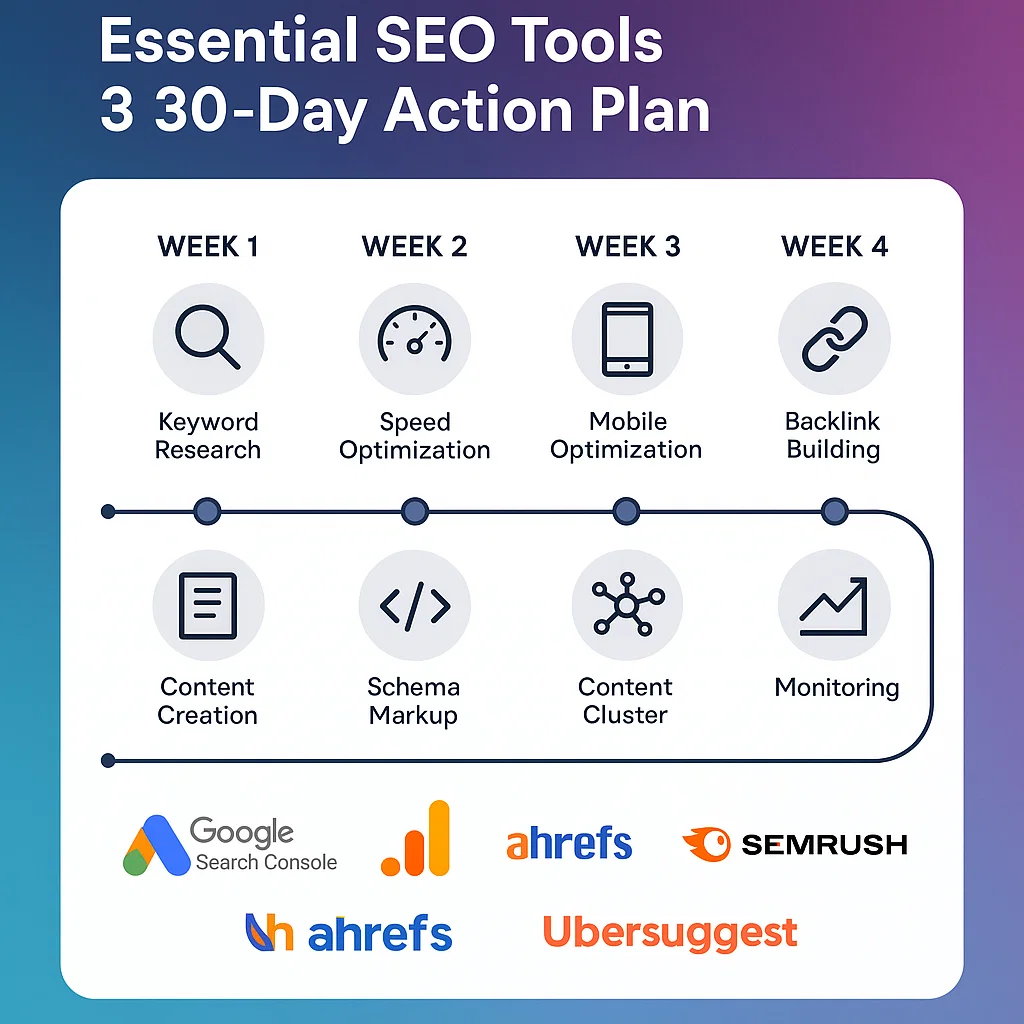
Week 1: On-Page Optimization
Days 1 – 2: Conduct keyword research for your main topic as well as related keywords.
Days 3-4: Optimize your title tags and meta descriptions to include long-tail and primary keywords.
Days 5-6: Review and improve your header tag structure (H1 H2, H2, the H3 tag).).
Days 7: Add internal links to your most important pages by using appropriate anchor text.
Week 2: Technical SEO Fixes
Days 8-9: Test your page speed using Google PageSpeed Insights and make improvements.
Days 10-11: Ensure your site is mobile-responsive and tested across devices.
Days 12-13: Install or verify your SSL certificate and HTTPS on all pages.
Days 14: Submit your XML sitemap to Google Search Console.
Week 3: Content Improvement
Days 15-17: Create comprehensive content that covers every aspect of your primary subject and long-tail keywords.
Days 18-19: Add schema markup and structured data to your pages.
Days 20-21: Create a content cluster strategy using pillars and cluster pages.
Week 4: Link Building and Promotion
Days 22-24: Identify guest posting opportunities and pitch relevant websites.
Day 25-26: Conduct a broken link investigation and contact the owners of websites.
Days 27-28: Create and submit your content to directories and platforms.
Days 29-30: Monitor your progress in Google Search Console and celebrate quick wins.
How to Sustain and Further Increase Your SEO Success
Continuous Improvement Mindset
SEO isn’t a one-time endeavor. Google’s algorithm is constantly changing and user behavior also changes. A successful SEO strategy requires constant optimization and ad-hoc adjustments. Stay informed about:
- Google algorithm updates
- Industry best practices
- Strategies for competing
- Tool updates and new features
Regular Monitoring and Updates
Create a review schedule for each month to:
- Find the for keyword rankings
- Monitor trends in traffic
- Review Google Search Console data
- Analyze user behavior
- Update content that is no longer relevant
Building Long-Term Authority
Remember, long-term SEO success is based on:
- Making content that is truly valuable
- Building high-quality backlinks naturally
- The focus should be on the user experience
- Keeping up with the optimization
- It is important to be patient. Results take 3-6 months
Measuring ROI
What matters is what you track:
- Organic traffic increase
- Improvements in the ranking of keywords
- Click-through rates
- Conversion rates
- Cost per acquisition
Frequently Asked Questions for improve SEO rankings
Q: What is the length of time it will take to improve SEO rankings?
A: Typically it takes 3-6 months to see noticeable improvements. Keywords that are competitive may take longer. Quality and consistency are more important than speed.
Q: Can I improve SEO rankings without spending money?
A: Yes! Organic SEO via the optimization of content, technical improvements and natural link construction is completely free. It does require the time and energy.
Q: How can I improve my SEO rank fast?
A: Focus on short-term wins, such as optimizing existing content or fixing technical issues and improving the user experience. However, sustainable rankings require long-term effort.
Q: What’s the best way to boost SEO for a small businesses?
A: Start with local SEO optimization, long-tail keywords within your industry, quality content, and establishing relationships with local businesses to get backlinks.
Q: How can I improve SEO ranking in just 30 days?
A: You can see improvement in CTR and metrics of user experience, but significant improvements in ranking tend to require more time. However the act of taking actions for 30 days builds momentum for growth in the future.
Conclusion: Your Path to SEO Success
Understanding how to improve SEO is among the most beneficial investments you can make to improve the online world. It doesn’t matter if you’re applying SEO optimization techniques, enhancing your website’s SEO by making technical improvements, or establishing authority with high-quality backlinks, each step is important.
Remember, the aim isn’t just to boost SEO rankings, but to provide genuine value for your users. If you concentrate on providing superior content and user experiences when you follow these techniques for optimizing your website and techniques, you will see higher rankings naturally follow.
Start with a section of the guide and follow it through it completely, then move on to the next. Consistent, strategic efforts over time will result in an increase in organic traffic and the exposure your business deserves.
Your journey to better SEO practices and higher rankings begins today. Make sure you are consistent, do your best and watch your site increase in rankings!